You may be thinking about using fixed-income ETFs to fill out your portfolio. Don’t. I continue to avoid fixed-income ETFs, as should you. The low liquidity of many bonds creates wide discount/premium gaps between the price and the net asset value (NAV) of the funds. If you buy the fund at a premium, you’re whacking yourself with a notional loss right out of the gate.
For quick proof, take a look at my chart of the iShares iBoxx $ Investment Grade Corporate Bond Fund (LQD). The top part of the chart shows the price and net asset value (NAV) of the fund. If you buy the fund when the price is higher than the NAV, you’re buying a dollar for more than a dollar.
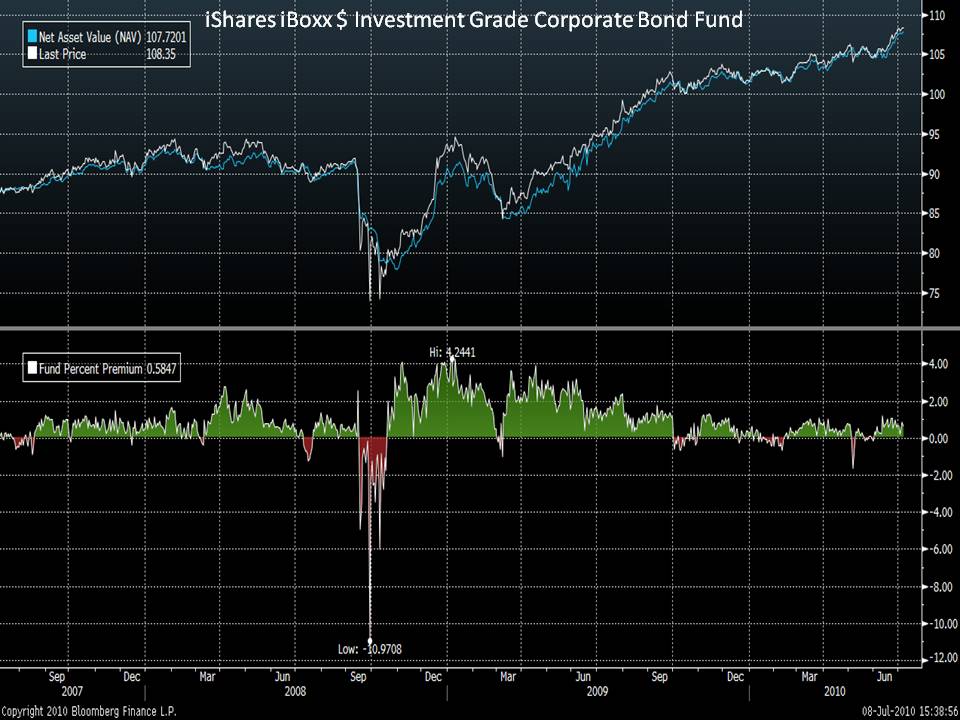
In green on the lower part of the chart is a representation of when the fund has been selling at a premium, or for more money than the bonds represented are worth on the open market. See how little red is on the chart? There doesn’t seem to be much of an opportunity to buy the underlying bonds for what they’re worth, let alone at a discount. Don’t forget about selling. Look at the dip in September on my chart. September sellers of LQD sold their shares for up to 11% below what they were worth. The illiquidity of the underlying portfolio of fixed-income ETFs makes investing in them a fool’s errand.
Modest yields today mean that if you pay more than 1% above the NAV, you could be giving up more than a quarter of your return in the first year. Even worse, imagine buying at a 1% premium and selling at a 1% discount. You’ve lost 2% in simple NAV misvaluation.
I continue to favor open-end mutual funds and individual bonds for my fixed-income portfolio, and so should you. For individual bond recommendations, subscribe to Young Research’s Global Investment Strategy.