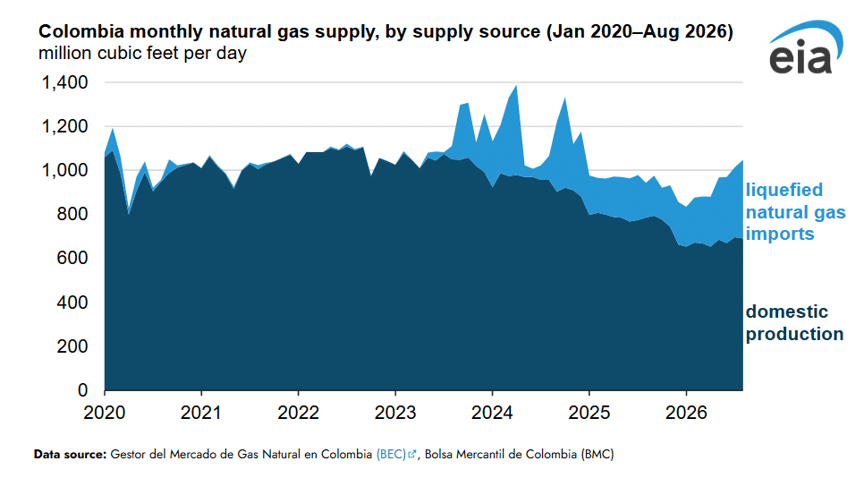
The U.S. Energy Information Administration (EIA) reports that Colombia is becoming increasingly dependent on liquefied natural gas (LNG) imports as domestic natural gas production declines. Average production fell from 1,070 million cubic feet per day (MMcf/d) in 2022 to 772 MMcf/d in 2025, dropping further to 673 MMcf/d during January–August 2026. LNG imports accounted for a record 31% of Colombia’s monthly natural gas supply in July 2026.
The supply challenges are compounded by declining output from major gas fields and a 39% reduction in proven reserves between 2022 and 2025. Meanwhile, an expected strong El Niño could bring drought conditions, reducing hydroelectric generation and increasing demand for natural gas-fired power generation.

Colombia currently has only one operating LNG import terminal, SPEC LNG near Cartagena, although several additional terminal projects and capacity expansions are planned to increase import capabilities.
Colombia faces growing natural gas supply challenges as domestic production and reserves decline while electricity demand could increase due to reduced hydropower availability. This is accelerating the country’s reliance on imported LNG and increasing the importance of new import infrastructure to energy security.