US Energy Information Administration reports that in 2025, natural gas prices in the US Pacific Northwest fell to historic lows due to record-high Canadian supply and weak regional demand. At Northwest Sumas, prices averaged $1.59 per MMBtu through August, hitting a record low of $0.56 in June. Increased renewable energy output and cooler weather reduced gas use for power generation, while cross-border imports from Canada remained strong. Storage levels stayed high, with the Jackson Prairie facility over 95% full in early September. They write:
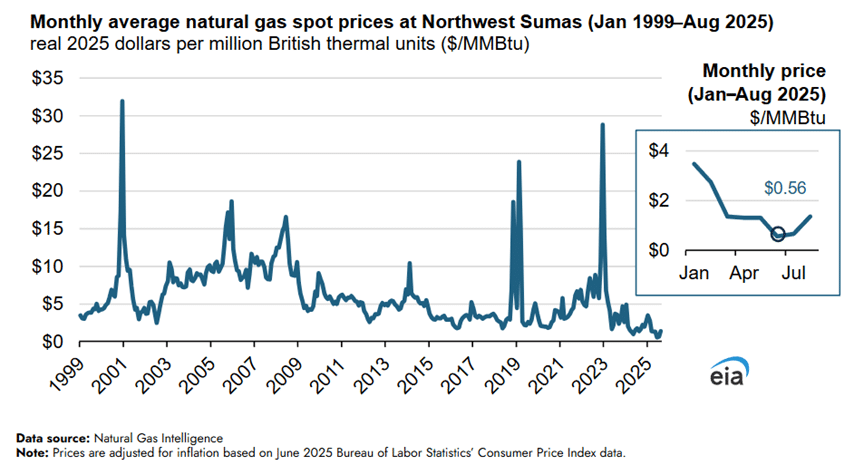
Monthly average natural gas spot prices in the northwestern United States reached historic lows in 2025, as ample supply from Canada coincided with subdued regional demand for natural gas-fired electricity. At Northwest Sumas, a key pricing hub for natural gas in the U.S. Pacific Northwest, the daily spot price averaged $1.59 per million British thermal units (MMBtu) in 2025 through August and reached its lowest ever monthly average price of $0.56/MMBtu in June, according to data from Natural Gas Intelligence. The monthly average price for the first eight months of this year is the lowest for this period of any year since at least 1999, and it is about 17% lower than in this same period in 2024.
Low prices at Northwest Sumas this year reflect robust Western Canadian supply of natural gas. Marketable natural gas production in Canada has set record highs this year, led by the Montney, a shale basin in British Columbia, and steady volumes from Alberta. British Columbia production averaged a record high of 7.8 billion cubic feet per day (Bcf/d) in July, and production in Alberta reached a high in March of 11.6 Bcf/d, according to data from S&P Global Insights. In addition, higher renewable generation in the electric power sector displaced some natural gas-fired output, while overall regional electricity demand was lower than the previous five-year average.
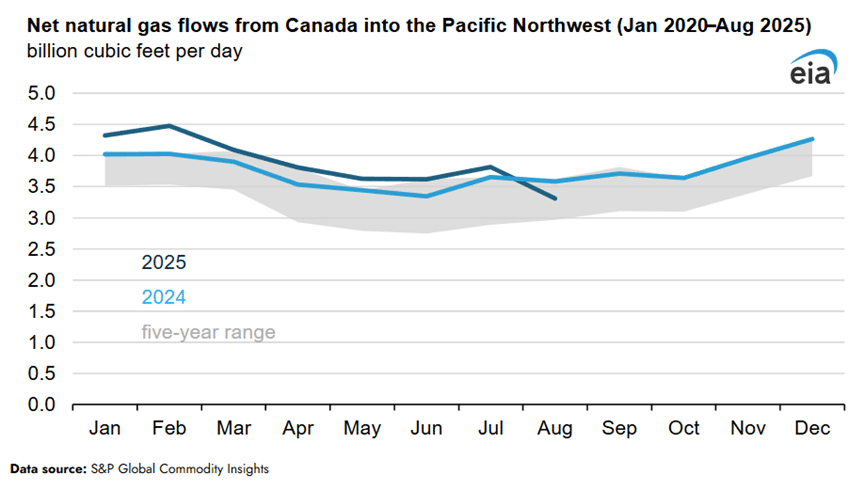
With plentiful upstream supply and minimal sustained pipeline capacity constraints this year, cross-border natural gas flows into the Pacific Northwest are also at record highs. Net flows from Canada into the Pacific Northwest averaged 4.5 Bcf/d in February 2025, the highest monthly average in data going back to 2012, before easing seasonally in late spring and into summer. The sharp decline in August reflected rising Western Canadian liquefied natural gas demand, diverting natural gas from the Pacific Northwest. However, a persistent positive price spread between Northwest Sumas and upstream Western Canadian hubs has continued to incentivize Canadian imports into the Pacific Northwest. From January through August 2025, this spread averaged 87 cents against Westcoast Station 2, the Western Canadian benchmark.
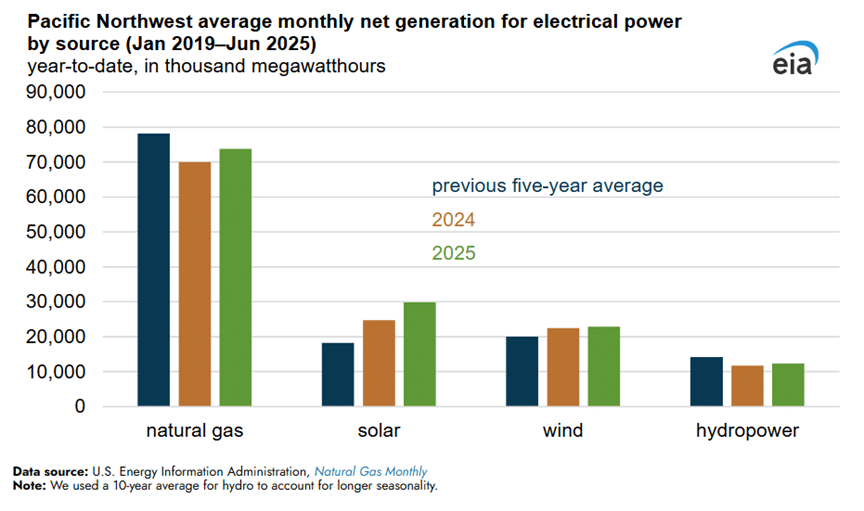
In the Pacific Northwest, natural gas use in the electric power sector has been mixed in 2025. Through the first half of the year (January–June), natural gas burn was about 5% higher than in 2024 but still 6% below the recent five-year average, according to data in our Natural Gas Monthly. Cooler summer weather reduced air-conditioning demand and limited natural gas consumption. Cooling degree days at Portland Airport were down 38% compared with last year and 21% below the previous five-year average.
At the same time, greater renewable generation further displaced natural gas in the region’s power mix. Compared with 2024, wind generation rose 2%, and solar generation rose 21%. Hydropower generation also was higher than last year, although it remained below the 10-year average. Relative to the previous five-year average, wind output increased 14%, and solar increased 64%. Together, mild weather and increased renewable output explain why regional natural gas consumption for electricity remained subdued despite higher Canadian supply into the region.
In the Pacific Northwest, natural gas inventories have remained consistently above the five-year average for the past two years. The Jackson Prairie underground storage facility, operated by Puget Sound Energy in southwest Washington, is the largest natural gas storage facility in the Pacific Northwest, with a working gas capacity of 24.6 Bcf. As of September 7, Jackson Prairie was more than 95% full, according to co-owner Williams.