The US Energy Information Administration reports that US ethane exports are set to rise significantly through 2026, driven by global demand for ethane as a petrochemical feedstock and expanding US export infrastructure. The EIA forecasts a 14% increase in American net ethane exports in 2025, followed by 16% growth in 2026. Major terminal expansions in Texas and Pennsylvania, along with new large-capacity tankers, are boosting export capabilities. China remains the top destination but faces slowing demand and regulatory hurdles. Meanwhile, Europe is increasing capacity with projects like INEOS’s new cracker in Belgium. Despite strong near-term growth, trade uncertainties and shifting feedstock preferences could impact long-term trends. They write:
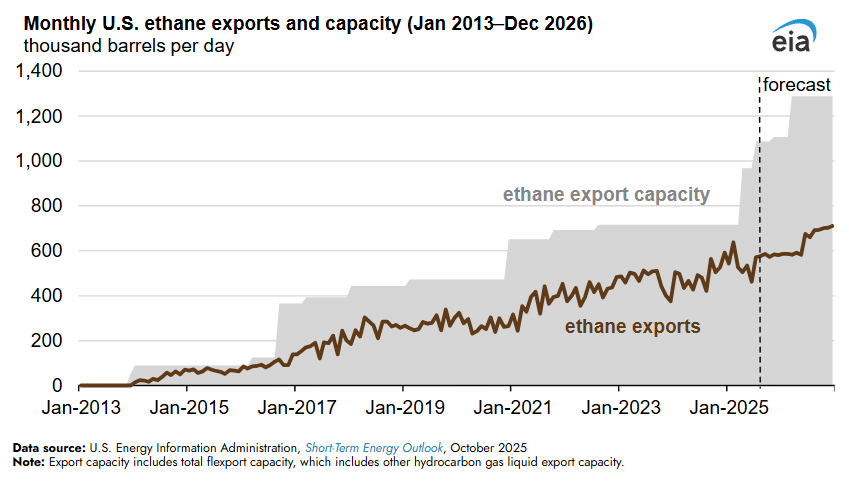
U.S. ethane exports are poised for significant growth through 2026, driven by robust global demand for ethane as a petrochemical feedstock, substantial U.S. export capacity expansions, and larger vessels to carry ethane exports. In our October Short-Term Energy Outlook, we forecast U.S. ethane net exports will grow 14% in 2025, followed by a 16% rise in 2026. The United States does not import ethane.
Ethane, a natural gas liquid primarily extracted from raw natural gas during processing, is a critical component in the petrochemical sector. It’s mainly used as a feedstock to produce ethylene, which is used to make a wide range of products including plastics, resins, and synthetic rubber.
The expansion of U.S. ethane export infrastructure supports export growth. Energy Transfer commissioned its Nederland facility in Texas in the second quarter of 2025 (2Q25), with capacity to export 250,000 barrels per day (b/d) of either ethane or propane. Energy Transfer will also expand its Marcus Hook, Pennsylvania, terminal by 20,000 b/d at the end of 2025. In July, Enterprise commissioned the Neches River ethane terminal in Texas, which has a capacity of 120,000 b/d. The second phase of the Neches River terminal is expected to come online in early 2026, adding 180,000 b/d of capacity. The addition of the Nederland flexport facility and first phase of the Neches River terminal increased U.S. ethane export capacity 16%; the second phase of Neches River terminal will expand it a further 21%.
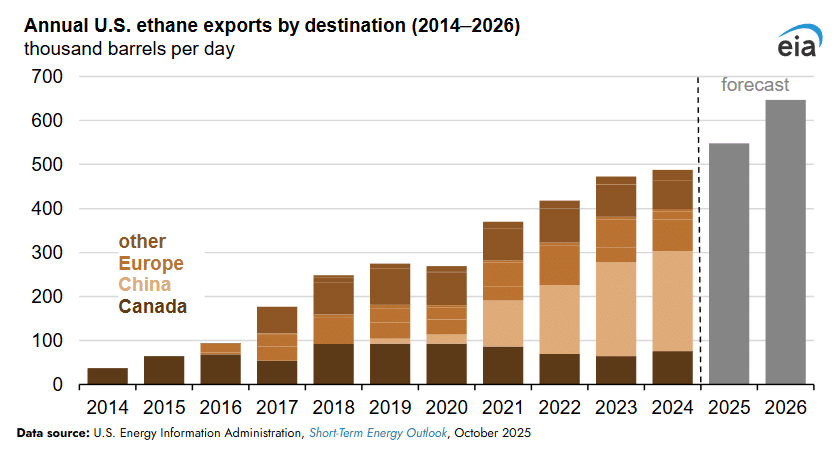
Developers in the United States are expanding ethane export capacity to meet increasing global demand for ethane as a petrochemical feedstock, particularly in China. China has historically been the largest destination for U.S. ethane, accounting for 47% of exports in 2024. However, demand growth in China is expected to slow in 2026 amid tightening product margins and oversupply of ethylene derivatives in East Asia.
New and reconfigured crackers in China have contributed to the country’s growing demand for ethane. Wanhua Chemical recently completed a second cracker in Yantai, China, in 1Q25, which takes ethane and naphtha as feedstock. According to Argus, Wanhua Chemical shut down its first cracker in Yantai, China, in June to begin a five-month conversion switch to ethane as a feedstock instead of the propane that it currently consumes.
Although new facilities and conversions are boosting U.S. ethane exports, potential slowdowns in demand growth and regulatory changes introduce some uncertainties beyond 2026. Two Chinese ethylene cracker projects have been delayed and may take naphtha as feedstock instead of ethane, following a notice issued by the U.S. Department of Commerce’s Bureau of Industry and Security in May requiring U.S. ethane exporters to obtain a special license to export ethane to China. The requirement ended on July 2. Although naphtha can be sourced from countries around the world, the United States is the only country capable of exporting waterborne ethane.
In Europe, the INEOS Project One cracker in Antwerp, Belgium, with a capacity of about 80,000 b/d of ethane, is slated to come online in 3Q26. This cracker will be the largest in Europe and one of the largest in the world, adding more petrochemical production in Northwest Europe.
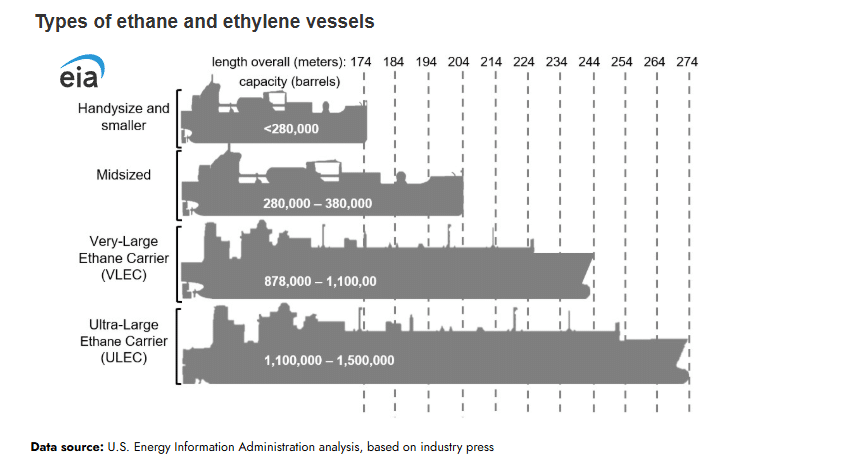
Not only is export capacity growing, but the vessels that carry ethane are getting bigger, with more capacity to support growing ethane demand. Tankers that can carry ethane range from handysize, which can carry ethane over short distances, to Ultra Large Ethane Carriers (ULECs), which are designed to carry up to 1.5 million barrels on intercontinental routes.
Eastern Pacific Shipping ordered six ULECs in 2024 to be delivered in 2027, which will be built in Chinese shipyards. Ten Very Large Ethane Carriers (VLECs) were also built in China, amounting to about 25% of the VLEC fleet. The U.S. Trade Representative plans to start implementing fees on Chinese built vessels in October (around $2 million per voyage), adding more uncertainty in U.S.-China ethane trade.