
Developers plan to add about 44.9 billion cubic feet per day of new natural gas pipeline capacity in the United States during 2026 and 2027, with most of the projects already under construction, according to the US Energy Information Administration.
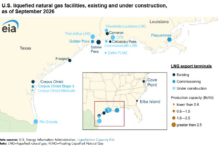
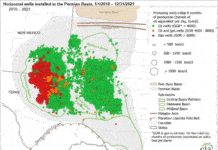
Texas will account for more than two-thirds of the new capacity, mainly to move additional natural gas out of the Permian Basin and reduce congestion at the Waha Hub, while Louisiana will add major capacity tied to LNG exports.

Key projects include the Rio Bravo Pipeline, Blackcomb Pipeline, and Hugh Brinson Pipeline in Texas, as well as the Port Arthur Pipeline, Louisiana Connector, and Pelican Pipeline in Louisiana. The expansions are designed to support LNG export terminals, power generation, industrial demand, and residential energy needs, while Virginia will also see added capacity through the Southeast Supply Enhancement Project.