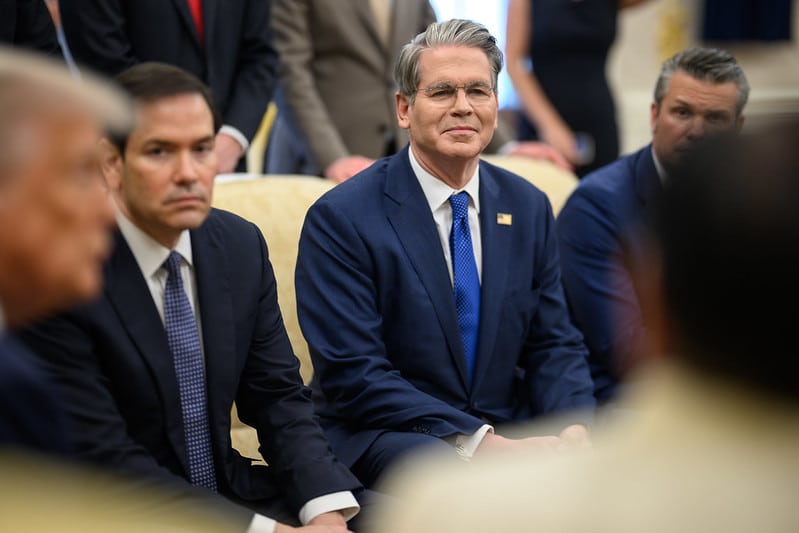
On Friday, Treasury Secretary Scott Bessent explained in an op-ed in The Wall Street Journal the dangers of the expanding responsibilities and power of the Federal Reserve. He noted the Fed’s expanded powers granted in the Dodd-Frank Act, and that fifteen years afterward, the results of granting the central bank those extra powers have been disappointing. He wrote:
Regulatory overreach compounds the problem. The Dodd-Frank Act dramatically enlarged the Fed’s supervisory footprint, transforming it into the dominant regulator of U.S. finance. Fifteen years on, the results are disappointing. The 2023 failure of Silicon Valley Bank illustrates the dangers of combining supervision and monetary policy. The Fed now regulates, lends to and sets the profitability calculus for the banks it oversees, an unavoidable conflict that blurs accountability and jeopardizes independence. A more coherent framework would restore specialization: empowering the Federal Deposit Insurance Corp. and Office of the Comptroller of the Currency to lead bank supervision, while leaving the Fed to macro surveillance, lender-of-last-resort liquidity and monetary policy.
At the heart of independence lies credibility and political legitimacy. Both have been jeopardized by the Fed’s expansion beyond its mandate. Heavy intervention has produced severe distributional outcomes, undermined credibility and threatened independence. Looking ahead, the Fed must scale back the distortions it causes in the economy. Unconventional policies such as quantitative easing should be used only in true emergencies, in coordination with the rest of the federal government. There must also be an honest, independent, nonpartisan review of the entire institution, including monetary policy, regulation, communications, staffing and research.
The U.S. faces short- and medium-term economic challenges, along with the long-term consequences of a central bank that has placed its own independence in jeopardy. The Fed’s independence comes from public trust. The central bank must recommit to maintaining the confidence of the American people. To safeguard its future and the stability of the U.S. economy, the Fed must re-establish its credibility as an independent institution focused solely on its statutory mandate of maximum employment, stable prices and moderate long-term interest rates.
Responding to Bessent’s op-ed in The New York Sun, former economic advisor to President Trump, Larry Kudlow, celebrates the coming “takeover” of the Fed by President Trump’s appointed governors. He writes:
As I have suggested, the economy, both present and future, is stronger than folks may think.
Unsurprisingly, President Trump responded with a brief post on Truth Social, saying, “Jerome ‘Too Late’ Powell should have lowered rates long ago.” Mr. Trump exclaimed: “As usual, he’s ‘Too Late.’”
Hopefully Mr. “Too Late” Powell will get the Fed’s fund target rate down to 3 percent from its current 4.5 percent by the end of this year.
Yet the bigger story is perhaps best summarized in a Wall Street Journal headline, “Trump Is Making Strides In His Takeover of the Fed,” as the Council of Economic Advisers chairman, Stephen Miran, is taking a leave of absence in order to temporarily fill a Fed seat on the central bank’s board of governors.
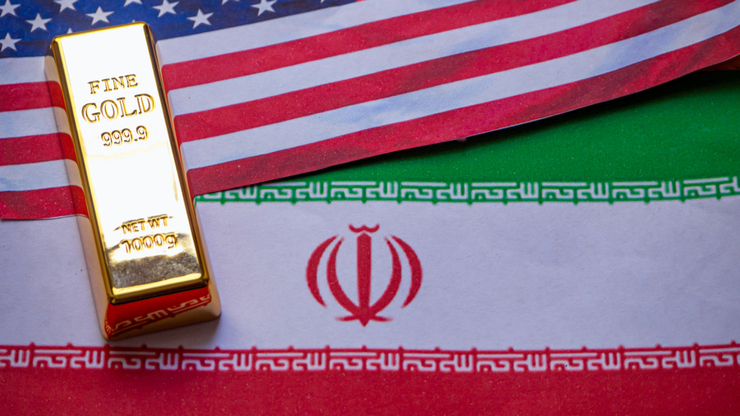
The New York Sun’s editors further riffed on Kudlow’s response with another editorial on September 7, wondering why Bessent hadn’t mentioned gold, and wondering why the administration hadn’t made more of the issue.
The first thing we did when we saw Mr. Bessent’s column was to scan it for the word “gold.” The monetary metal was unmentioned. That strikes us as odd. On that very day, after all, the value in terms of gold at which greenbacks were trading was about to set a new low of less than a 3,558th of an ounce of the monetary metal. When graphed it’s at the bottom of a decades-long slide. It’s the lowest value in terms of gold ever recorded for the greenback.
We understand that, in the age of fiat money, the legislated value of the dollar is not supposed to matter. In 1971, Nixon closed the gold window at which foreign governments could redeem dollars they held at a 35th of an ounce of gold. In 1973, Congress set the value of the dollar at a 42.22nd of an ounce of gold. Yet Uncle Sam hasn’t enforced that. It is amazing just how loath is our leadership at the Treasury and the Federal Reserve to open up this issue.
What’s so startling about the official silence on the collapse of the dollar is that Mr. Bessent and, above him, President Trump would be — or so it seems to us — a promising pair to take on the issue of fiat money. In the 2016 Republican primaries, moreover, Mr. Trump was widely quoted as saying, per NPR, “Bringing back the gold standard would be very hard to do, but, boy, would it be wonderful. We’d have a standard on which to base our money.”
It doesn’t appear likely that Trump or Bessent will lead a push for a return to the gold standard. The immediate effects of such a move would be counter to the greater priorities Trump has signalled in increasing American manufacturing. If a gold standard were introduced, the value of a dollar would likely soar in comparison to international fiat currencies, and imports could become cheaper relative to American manufactured goods, driving up imports and driving down American manufacturing jobs. Those looking for America to return to the gold standard will likely be waiting for another president.