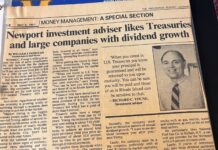

Back in 1991 I addressed the most terrifying aspect of saving for retirement that any investor can face, the prospect of outliving your money. I cannot impress upon you enough the importance of saving more than you think you’ll need.
Those of you who have been diligently saving and intelligently diversifying your portfolio through the last nine years of historically low interest rates are surely wondering if your savings will hold up after you retire. Ultra-low interest rates from the Fed have been a direct assault on retirees and savers. But now rates are rising, and you have the opportunity to participate in my 1% miracle.
I wrote the following back in 1991. The numbers for inflation and return don’t coincide with today’s reality, but the principles remain the same. Capturing higher rates of return as interest rates rise can have a big effect on your spendable income. I wrote then:
Do you believe in miracles?
Try this one for size. I call it DICK YOUNG’S 1% MIRACLE, and I think you’ll be stunned.
I want to show you how just a 1% increase in your average annual investment income can increase the annual earnings from your investment portfolio by 40%. “Right Young,” you say, “a 1% increase in income can translate into a 40% increase in earnings? Give me a break.” But hold on, here’s the miracle—along with instruction on how to apply my miracle to your own investment program today. See if you can beat this!
SPENDABLE INCOME ON $1 MILLION IS ONLY $20,000
Let’s assume, for illustration, that you have a $1 million pool of retirement cash. Let’s also assume 5% inflation, an annual 9% return on your capital, and a fair tax bite. Okay, 9% translates into $90,000 gross income on $1 million. With a 5% inflation rate, you must plow back $50,000 to capital to maintain future buying power. Most investors forget all about the inflation cancer that eats away at portfolio buying power. If you do not add back to your capital annually at the inflation rate, you are badly kidding yourself. Now, let’s assume $20,000 in taxes—I’m being kind—on a $90,000 gross income. Don’t worry about the preciseness of this tax figure; it doesn’t matter, as you’ll soon see.
After tucking away $50,000 to maintain purchasing power and paying $20,000 in taxes, your spendable income is only $20,000. That’s it! And yes, that is the maximum I would personally plan to spend today out of $1 million in retirement capital. I know it’s not a lot of money, but if you spend more, you are eating into your capital. Now you see why the financial problems of retirement are much more difficult than explained to you by most fuzzy-thinking financial planners. You cannot consume the host!
Increase Earnings 1%, Increase Spendable Income 40%
Now assume you increase your portfolio income by just 1%, to 10% from 9%. Gross portfolio income now becomes $100,000, up from $90,000. Tuck away the same $50,000 to maintain portfolio purchasing power, and pay taxes of $22,000 instead of $20,000, and what do you get? Instead of $20,000 spendable income, your spendable income becomes $28,000. How does $28,000 relate to $20,000? It’s an increase of 40% in spendable income, just as I promised would be the case. To get this unbelievable 40% increase in income, all that was needed was to improve your portfolio income by an annual 1%.
You, of course, are looking for flaws in my 1% miracle. But there are no flaws. And you are astounded at how little spendable income is available on $1 million at a 5% rate of inflation. You’re not accepting what I’m telling you warmly and happily because the level of spendable income I’m suggesting is so unappealingly low.
Don’t Destroy Your Capital Base
Don’t fall for the tempting argument that $1 million is such a large sum, you can afford to accept a 5% per year decrease in earning power due to inflation—or even to dip into principal. To help you stay on the straight and narrow, ask yourself: “Do I expect to be alive 15 years from now?” Most people will answer yes—and with today’s longer life spans, that’s being realistic. If you retire at age 65, you stand a good chance of reaching 80. And if you retire early at age 55, as so many are doing, you certainly expect to be alive and kicking at 70. You definitely don’t want to find yourself broke at either age 70 or 80.
How can you boost your return by 1% without magnifying risk? Craft a diversified portfolio and eliminate emotionalism from your investment process. That’s easier said than done. If you need help, consider that Vanguard estimates that the potential gain from using an advisor to help manage your portfolio can add as much as 3% per year to your return. Working with an advisor on strategies such as rebalancing your portfolio, appropriate asset allocation, building a spending strategy, and most importantly guidance on what investments to make and which not to make can have a significant positive effect on your returns.
For a glimpse at how my family run investment counsel service helps clients implement those strategies, signup for the monthly client letter (free even for non-clients) from Richard C. Young & Co., Ltd.
Originally posted on Youngsworldmoneyforecast.com.