
U.S. small-scale or rooftop solar generation (systems with less than 1 megawatt of capacity) rose sharply over the past decade, from 18,812 GWh to 92,979 GWh. In 2025, California led the country with 34,411 GWh, accounting for 37% of total U.S. generation, followed by Arizona with 5,795 GWh. Texas and Florida have also grown rapidly, increasing from 391 GWh and 205 GWh in 2016 to 5,408 GWh and 5,198 GWh, respectively, in 2025. New York ranks fifth despite having fewer solar resources, thanks to technology improvements and state incentives.
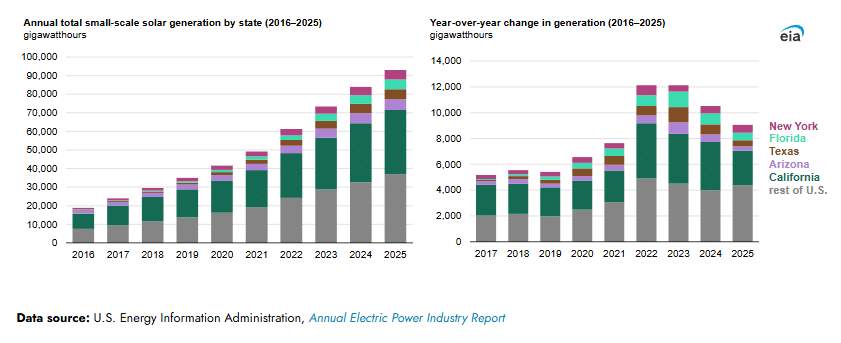
Rooftop solar growth has been driven by increased installed capacity, tax credits, property tax exemptions, and net metering programs. In California, generation grew by 8% between 2024 and 2025 as capacity increased from 18 GW to 20 GW. Arizona offers a 25% state income-tax credit, while other states, including New York, New Jersey, Massachusetts, and Illinois, support solar adoption through incentive programs. U.S. rooftop solar generation grew by 25% in 2022, partly due to record capacity additions and incentives such as California’s NEM 2.0 program, which offered more favorable compensation for excess electricity than the subsequent NEM 3.0 program. However, the overall growth rate has slowed since 2022.