The US Energy Information Administration reports that while most US electricity markets now rely more on natural gas than coal, two Midwest regions—Southwest Power Pool (SPP) and Midcontinent Independent System Operator (MISO)—still generate more electricity from coal during winter months. Although natural gas has largely overtaken coal nationwide, coal remains competitive in these regions during cold months due to high heating demand and potential gas supply constraints. However, with aging coal plants and newer, more efficient gas facilities in place, coal’s dominance is expected to decline over time. The EIA writes:
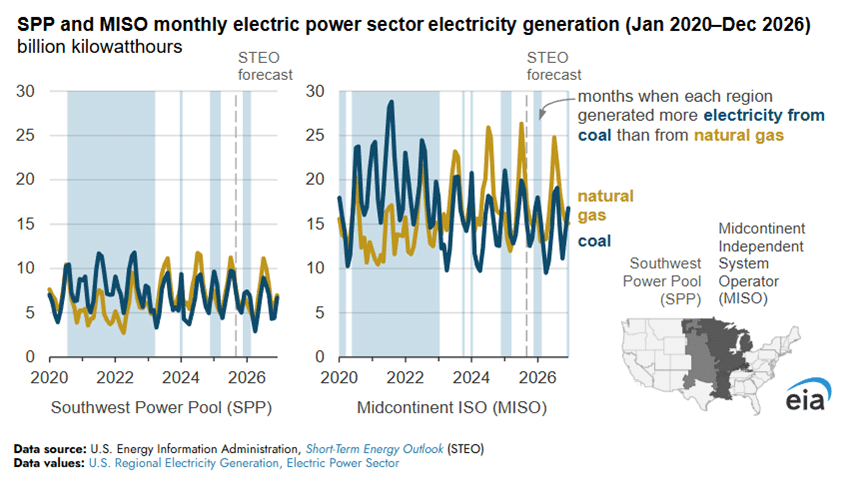
Two electricity markets in the Midwest still generate more electricity from coal than from natural gas in at least some months of the year: Southwest Power Pool (SPP) and the Midcontinent Independent System Operator (MISO). We expect these two regions will generate more electricity from coal than from natural gas in some upcoming winter months, based on forecasts in our latest Short-Term Energy Outlook.
As recently as 2021 and 2022, both SPP and MISO were producing more electricity from coal than from natural gas in every month of the year. More recently, coal has exceeded natural gas only in the winter months, when demand for space heating and related demand for electricity increase. In MISO and SPP, we expect coal generation to exceed natural gas generation from December 2025 through February 2026.
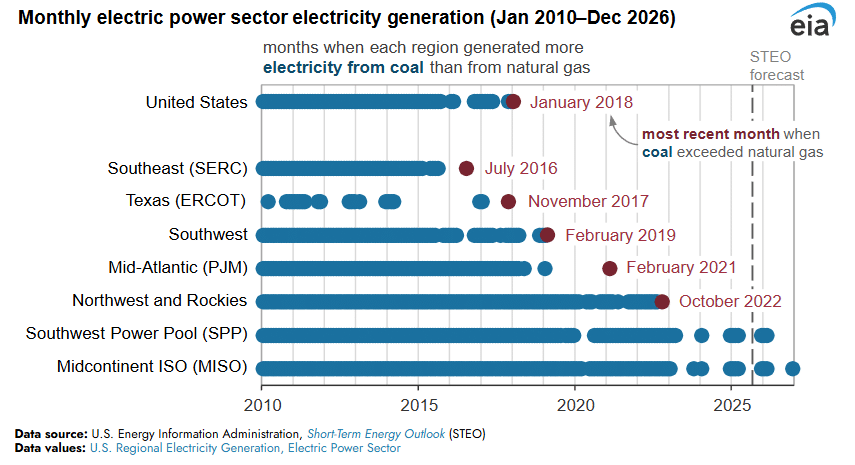
Natural gas and coal were the top two sources of electric power sector generation in the United States in almost every year from 2009, when natural gas surpassed nuclear, through 2023, when coal fell below nuclear. In all other electricity market regions except SPP and MISO, natural gas regularly provides more electricity than coal.
The United States as a whole last generated more electricity from coal than from natural gas on a monthly basis in January 2018. Several regional electricity markets such as those in California, Florida, New England, and New York have not generated more electricity from coal than from natural gas at any point since at least 2010—the first year of our data series for these electricity markets.
In the SPP and MISO markets, coal remains competitive, especially when natural gas prices are relatively high. In the winter, natural gas supply may face constraints such as production freeze-offs or other supply constraints that affect the dispatch of natural gas-fired power plants.
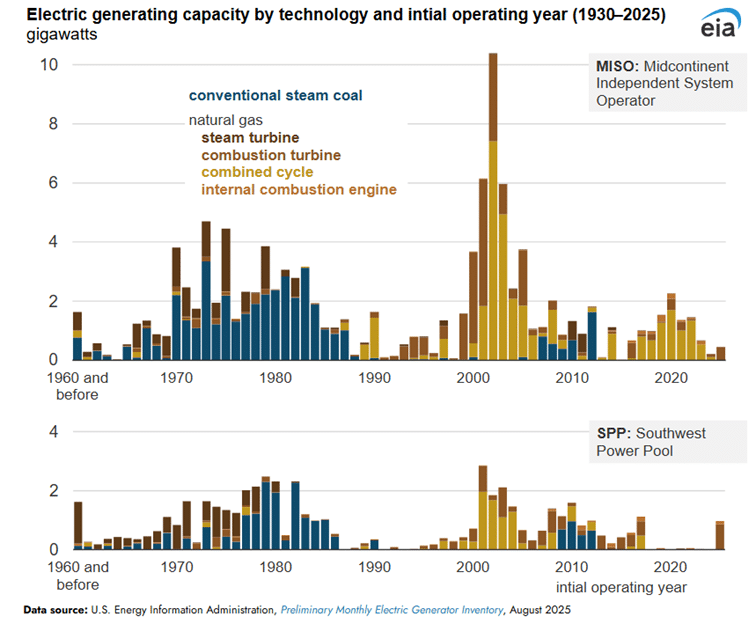
We expect natural gas to continue to gain market share in these regions as older, less efficient coal-fired generators retire. With the exception of a few coal-fired generators that came online in the late 2000s and early 2010s, nearly all of the coal-fired capacity in these two regions came online before 1990. By comparison, much of the natural gas capacity in SPP and MISO is from the newer and relatively efficient combined-cycle units that have come online since 2000.