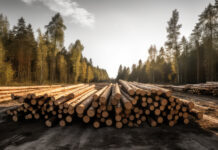
President Donald Trump has signed a proclamation imposing new global tariffs on timber, lumber, and wood products under Section 232 of the Trade Expansion Act, citing national security concerns. The move includes a 10% tariff on softwood lumber and 25% tariffs on upholstered furniture and kitchen cabinets—set to rise to 30% and 50%, respectively, in January. The tariffs aim to reduce US reliance on foreign wood imports, counter unfair trade practices, and strengthen domestic industry. Select allies like the UK, EU, and Japan will receive more favorable treatment. The action builds on Trump’s broader efforts to protect critical U.S. industries and supply chains. The White House writes:
Today, President Donald J. Trump signed a Proclamation invoking Section 232 of the Trade Expansion Act of 1962 (Act) to impose tariffs on imports of timber, lumber, and their derivative products (wood products) to bolster American industry and protect national security.
- The Proclamation imposes a 10% global tariff on imports of softwood lumber.
- The Proclamation imposes a 25% global tariff on certain upholstered furniture, which will increase to 30% on January 1.
- The Proclamation imposes a 25% global tariff on kitchen cabinets and vanities, which will increase to 50% on January 1.
- Trading partners who negotiate with the United States to address the threat of wood imports to the national security of the United States may be able to secure an alternative to the pending tariff increases.
- The United Kingdom, the European Union, and Japan will enjoy more favorable treatment that reflects the terms of their trade deals with the United States.
- The Section 232 tariff on subject wood imports from the United Kingdom will not exceed 10%.
- The combined Section 232 tariff and most-favored nation tariff on subject wood imports from the European Union and Japan will not exceed 15%.
- Products that are not subject to these Section 232 tariffs will generally be subject instead to reciprocal tariffs.
- The treatment of products on the list of Potential Tariff Adjustments for Aligned Partners (PTAAP) remains unchanged unless an antidumping or countervailing duty order applies.
ADDRESSING THE THREAT TO NATIONAL SECURITY: The Proclamation follows the Secretary of Commerce’s completion of a Section 232 investigation under the Act, which found that the present quantities and circumstances of the imports of wood products threaten to impair the national security.
- President Trump recognizes that an overreliance on foreign timber, lumber, and their derivative products could jeopardize the United States’ defense capabilities, construction industry, and economic strength.
- Wood products serve as essential inputs across multiple sectors, supporting national defense, critical infrastructure, economic stability, and industrial resilience in the United States.
- Lumber plays a vital role in civilian construction and military infrastructure.
- The U.S. military spends over ten billion dollars annually on construction and is testing innovative wood products such as cross-laminated timber.
- It is vital for the United States to possess manufacturing capabilities in the wood and lumber sector to ensure readiness and guarantee the national security.
- The United States has been a net importer of lumber since 2016, despite having the practical production capacity to supply 95% of the United States’ 2024 softwood consumption.
- Foreign supply chains and major exporters increasingly fill U.S. demand, creating vulnerabilities to disruptions.
- America’s reliance on imported lumber is exacerbated by foreign government subsidies and predatory trade practices, which undermine the competitiveness of the U.S. wood products industry.
- By imposing tariffs on wood products, President Trump is countering foreign subsidies and predatory practices that distort markets, making imported lumber less competitive and incentivizing the growth of domestic wood production to achieve self-sufficiency and mitigate supply chain risks to national security.
BUILDING ON A RECORD OF SECURING CRITICAL INDUSTRIES AND SUPPLY CHAINS: This Proclamation builds on previous actions taken by the Trump Administration to ensure U.S. trade and industrial policies serve the national interest.
-
On Day One, President Trump established his America First Trade Policy to make America’s economy great again.
-
President Trump has repeatedly used Section 232 tariffs to protect against threats to our national security and to strengthen manufacturing critical for our national and economic security, including on steel, aluminum, copper, and autos.
- The Department of Commerce is currently conducting additional investigations, including on semiconductors, pharmaceuticals, commercial aircraft, wind turbines, robotics, unmanned aircraft systems, and personal protective equipment.
-
President Trump imposed reciprocal tariffs to take back America’s economic sovereignty, address nonreciprocal trade relationships that threaten our economic and national security, and to remedy the consequences of nonreciprocal trade.
-
President Trump has issued several Executive Orders, Proclamations, and Presidential Memoranda to boost mining, manufacturing, and investment in domestic industry, including by reducing regulations and eliminating bureaucracy.
Read more here.