
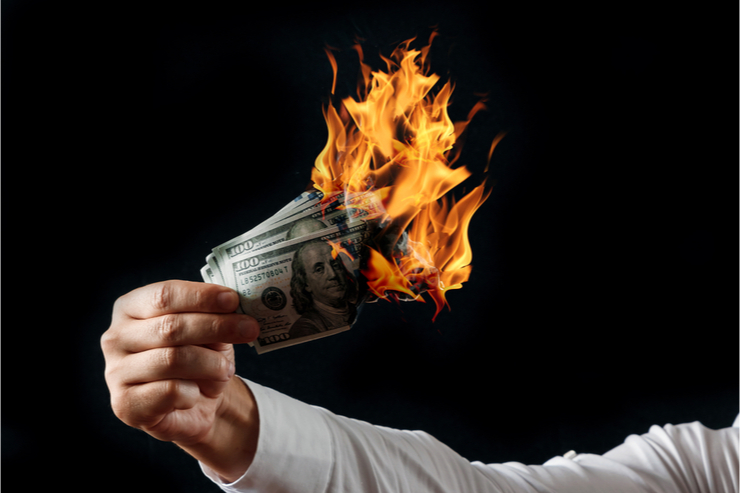
You have been telling me about the inflation you’re seeing in your life. It’s not good. Inflation can throw all the calculations of a well-planned retirement into chaos. Even people who are still working need to readjust in the face of higher prices. When those old dollars you saved after working hard aren’t worth as much as you’d thought they’d be, life gets trickier.
Now, Roger Bootle, the man who officially declared inflation dead in a 1996 book title The Death of Inflation: Surviving and Thriving in the Zero Era (no relation to my monthly Survive & Thrive newsletter, which you can sign up for here for free) thinks Americans should begin worrying about inflation again. Bloomberg‘s David Goodman writes:
A quarter of a century after declaring the death of inflation, Roger Bootle is seeing signs of its rebirth.
Pockets of price growth are emerging from the cost of used cars to lumber as the world starts to recover from the coronavirus pandemic. That’s pushed borrowing costs in financial markets to multi-year highs in major economies. While most central bankers seem content the higher gains are transitory, some economists are sounding the alarm.
Among them is Bootle, founder of Capital Economics and author of the 1996 book “The Death of Inflation: Surviving and Thriving in the Zero Era.” Back then, he argued decades of consistently high rates had come to an end.
While he doesn’t yet see a return to that era, in an interview with Bloomberg on June 2, Bootle argued the world is on the cusp of another turning point.
The conversation has been condensed and edited for clarity.
In the 1990s you identified the start of a new era for inflation. Do you think this is the start of another sea change?
Roger Bootle: “It is the start of a sea change, I have to say. That’s not to say that we’re going to go back to the strong inflationary conditions of the 70s and early 80s. But at the very least, I think we are at the end of the crypto-deflationary period that we’ve been in for the last few years.
“The danger of deflation has passed, and the risks have definitely tilted in the other direction. How high inflation will go, and for how long, that’s debatable. But I’m not in much doubt myself that there’s been a sea change.”
What are the broad trends coloring your outlook?
“You’ve got to draw a distinction between two key influences, and then policy on top, so three things to look at. The first is on the supply side — cost factors and institutional factors.
“Then, globalization, the collapse of trade unions and the intensification of competition — all those things, which I thought were, if you like, acting a bit like a reverse oil shock — presented a series of downward price shocks. There’s still room for some of those things to appear and continue. But the tide has turned, and the risks are very much the other way.”
Is there any particular areas of concern?
“If I had to put my money on a single factor that was going to push up costs in the years to come, I would say it was the environmental emphasis and in particular the drive towards net-zero. This is going to lead to a whole series of costs and price increases across the economy.
“The second element is demand. In the era before low inflation, it was common for policymakers and academics to completely ignore supply side institutional factors as being quite irrelevant — it’s all about money.
“When you look at the demand factors, it’s pretty striking. We’re entering in a period when demand is going to be strong. We’ve got this pent-up demand because of Covid. You’ve got people with lots of money.
Do you think that a degree of complacency is creeping in with policy makers?
“I’m not sure complacency is quite the right word. I think it’s over-optimism with regard to inflation, but on two counts. One that’s it’s not going to go up that much, at least not sustainably. And two, if it does, as and when they need to, they’re going to be able to contain it.
Action Line: Don’t get complacent about inflation or your portfolio planning. Save until it hurts, because you might need every extra dollar if inflation kicks off in a big way. You should start early. Get started right after graduating. I tell you how in my free special report, How To Invest After Graduating College. Click here to get your copy now.
Originally posted on Your Survival Guy.