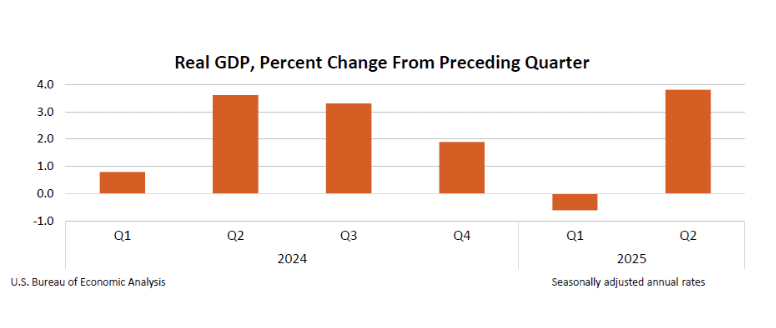
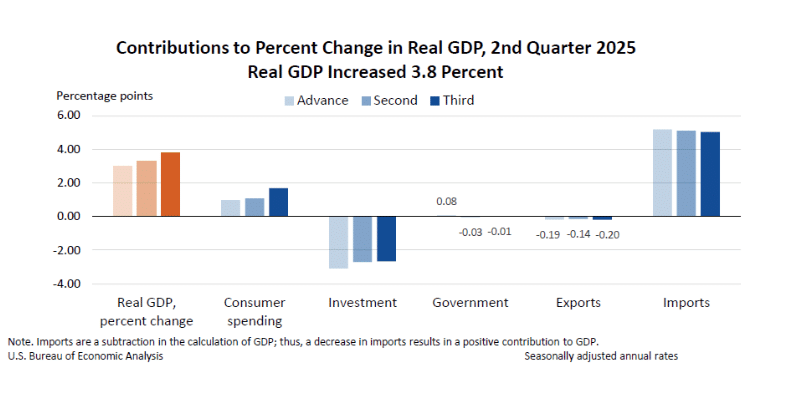
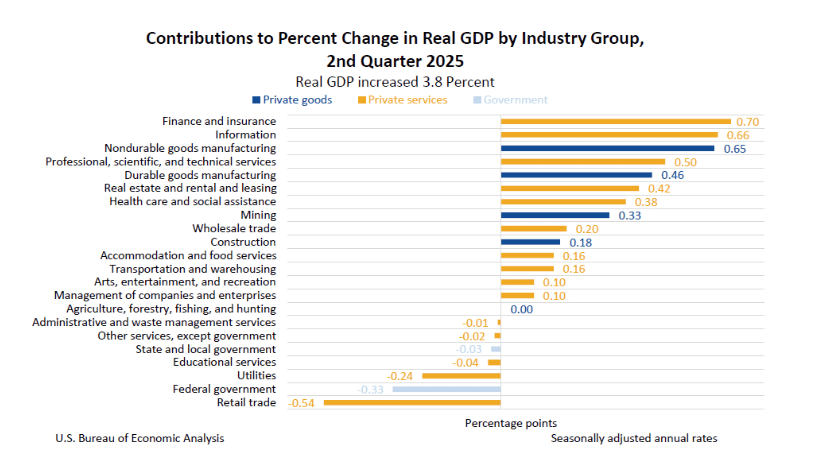
The Bureau of Economic Analysis reports that real gross domestic product (GDP) increased at an annual rate of 3.8 percent in the second quarter of 2025, recovering from a 0.6 percent decrease in the first quarter, according to the U.S. Bureau of Economic Analysis. This growth was mainly driven by a decline in imports and a rise in consumer spending, partially offset by decreases in investment and exports. Real final sales to private domestic purchasers rose 2.9 percent, boosted by gains in private goods-producing industries (10.2 percent) and private services-producing industries (3.5 percent), while government sector output declined by 3.2 percent. The second estimate of GDP was revised upward by 0.5 percentage points due to increased consumer spending. The BEA writes:
Real gross domestic product (GDP) increased at an annual rate of 3.8 percent in the second quarter of 2025 (April, May, and June), according to the third estimate released by the U.S. Bureau of Economic Analysis. In the first quarter, real GDP decreased 0.6 percent (revised).
The increase in real GDP in the second quarter primarily reflected a decrease in imports, which are a subtraction in the calculation of GDP, and an increase in consumer spending. These movements were partly offset by decreases in investment and exports.
Real GDP was revised up 0.5 percentage point from the second estimate, primarily reflecting an upward revision to consumer spending. For more information, refer to the “Technical Notes” below.
Compared to the first quarter, the upturn in real GDP in the second quarter primarily reflected a downturn in imports and an acceleration in consumer spending that were partly offset by a downturn in investment.
Real final sales to private domestic purchasers, the sum of consumer spending and gross private fixed investment, increased 2.9 percent in the second quarter, revised up 1.0 percentage point from the previous estimate.
From an industry perspective, the increase in real GDP reflected increases of 10.2 percent in real value added for private goods-producing industries and 3.5 percent for private services-producing industries that were partly offset by a decrease of 3.2 percent in real value added for government.
Real gross output increased 1.2 percent in the second quarter, reflecting increases of 0.6 percent for private goods-producing industries and 1.7 percent for private services-producing industries that were partly offset by a decrease of 0.7 percent for government.
The price index for gross domestic purchases increased 2.0 percent in the second quarter, revised up 0.2 percentage point from the previous estimate. The personal consumption expenditures (PCE) price index increased 2.1 percent, revised up 0.1 percentage point. Excluding food and energy prices, the PCE price index increased 2.6 percent, also revised up 0.1 percentage point.
Real gross domestic income (GDI) increased 3.8 percent in the second quarter, revised down 1.0 percentage point from the previous estimate. The average of real GDP and real GDI increased 3.8 percent, revised down 0.2 percentage point.
Profits from current production (corporate profits with inventory valuation and capital consumption adjustments) increased $6.8 billion in the second quarter, a downward revision of $58.7 billion.