Real GDP grew 0.5% in Q4 2025, down from 4.4% in Q3. Consumer spending and investment drove growth while government spending and exports declined. Full-year GDP rose 2.1%, led by services and investment.
Corporate Profits and Prices:
Corporate profits increased $246.9 billion in Q4 and $275.7 billion for 2025. The PCE price index rose 2.9% in Q4 and 2.6% for the year. Core inflation remained steady.
States and Income:
Real GDP increased in 35 states in Q4. Personal income rose in 47 states and D.C. For 2025, all states and D.C. saw GDP and income growth. Hawaii recorded strong gains due to a wildfire settlement.
Summary:
The economy showed moderate Q4 growth with rising corporate profits and personal income. Inflation remained moderate, keeping annual GDP growth at 2.1%. The BEA writes:
Real gross domestic product (GDP) increased at an annual rate of 0.5 percent in the fourth quarter of 2025 (October, November, and December), according to the third estimate released today by the U.S. Bureau of Economic Analysis. In the third quarter of 2025, real GDP increased 4.4 percent.
The third report for the fourth quarter of 2025, originally scheduled for March 27, 2026, was rescheduled due to the October–November 2025 government shutdown.
Real GDP was revised down 0.2 percentage point from the second estimate, primarily reflecting a downward revision to investment. For more information, refer to the “Technical Notes” below.
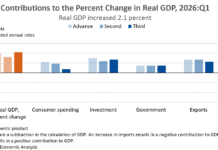
The contributors to the increase in real GDP in the fourth quarter were increases in consumer spending and investment. These movements were partly offset by decreases in government spending and exports. Imports, which are a subtraction in the calculation of GDP, decreased.
GDP by industry
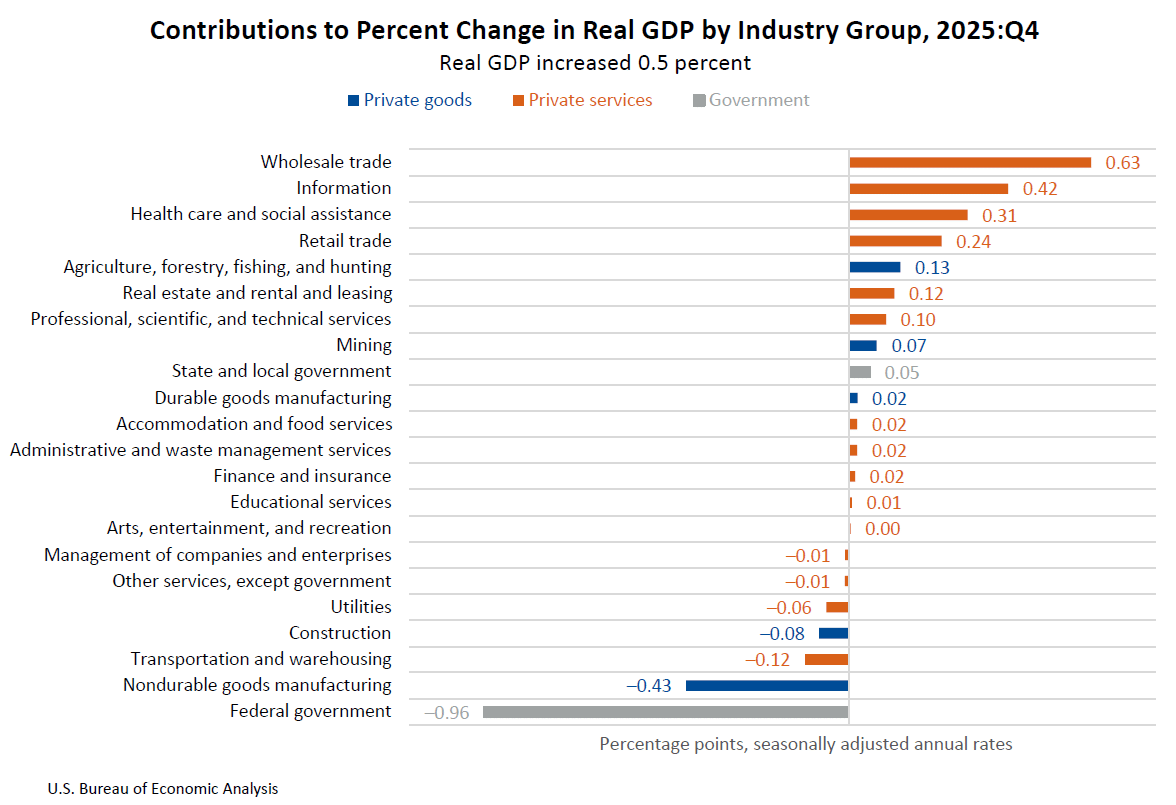
From an industry perspective, the increase in real GDP reflected an increase of 2.3 percent in real value added for private services-producing industries that was partly offset by decreases of 7.8 percent in government and 1.8 percent in private goods-producing industries. The leading industry contributors to the increase in real GDP were wholesale trade, information, and health care and social assistance.
Related economic measures
Real final sales to private domestic purchasers, the sum of consumer spending and gross private fixed investment, increased 1.8 percent in the fourth quarter, revised down 0.1 percentage point from the previous estimate.
Real gross output decreased 0.5 percentin the fourth quarter, reflecting decreases of 3.2 percent for private goods-producing industries and 4.7 percent for government that were partly offset by an increase of 1.1 percent for private services-producing industries.
Real gross domestic income (GDI) increased 2.6 percent in the fourth quarter, compared with an increase of 3.5 percent in the third quarter. The average of real GDP and real GDI increased 1.5 percent in the fourth quarter, compared with 4.0 percent in the third quarter.
Profits from current production (corporate profits with inventory valuation and capital consumption adjustments) increased $246.9 billion in the fourth quarter, compared with an increase of $175.6 billion in the third quarter.
The price index for gross domestic purchases increased 3.7 percent in the fourth quarter, revised down 0.1 percentage point from the previous estimate. The personal consumption expenditures (PCE) price index increased 2.9 percent, and the PCE price index excluding food and energy increased 2.7 percent, both the same as previously estimated.
Real GDP and Related Measures
[Percent change (SAAR) from 2025:Q3 to 2025:Q4]
Advance Estimate
Second Estimate
Third Estimate
Real GDP
1.4
0.7
0.5
Current-dollar GDP
5.1
4.5
4.2
Real final sales to private domestic purchasers
2.4
1.9
1.8
Real GDI
…
…
2.6
Average of real GDP and real GDI
…
…
1.5
Gross domestic purchases price index
3.7
3.8
3.7
PCE price index
2.9
2.9
2.9
PCE price index excluding food and energy
2.7
2.7
2.7
U.S. Bureau of Economic Analysis
GDP by state
From a regional perspective, real GDP increased in 35 states in the fourth quarter of 2025, with the percent change at an annual rate ranging from 3.8 percent in North Dakota to –8.3 percent in the District of Columbia and remaining unchanged in Indiana and Maine.
Agriculture, forestry, fishing, and hunting was the leading contributor to the increase in real GDP in North Dakota. Federal civilian was the leading contributor to the decrease in the District of Columbia.
Personal income by state
In the fourth quarter of 2025, current-dollar personal income increased $217.9 billion, or 3.4 percent at an annual rate. Personal income increased in 47 states and the District of Columbia, with the percent change at an annual rate in current-dollar personal income ranging from 41.5 percent in Hawaii to –4.0 percent in North Dakota.
Earnings(compensation plus proprietors’ income) increased in 43 states. The percent change in earnings ranged from 5.9 percent in Massachusetts to –7.1 percent in the North Dakota.
Personal current transfer receipts increased in 42 states and the District of Columbia. The percent change in transfer receipts ranged from 343.4 percent in Hawaii to –4.2 percent in Iowa. The increase in transfer receipts in Hawaii reflected a settlement paid by a domestic electric utility to U.S. households to compensate for claims of personal injury, property damage, and other losses related to the 2023 Maui wildfire.
Property income(dividends, interest, and rent) increased in all 50 states and the District of Columbia. The percent change ranged from 2.6 percent in Wyoming to 0.9 percent in West Virginia.
Annual estimates
Real GDP increased 2.1 percentin 2025 (from the 2024 annual level to the 2025 annual level), the same as previously estimated. The increase in real GDP in 2025 primarily reflected increases in consumer spending and investment.
From an industry perspective in 2025, real value added for private services-producing industries increased 2.7 percent, private goods-producing industries increased 1.2 percent, and government increased less than 0.1 percent. From a regional perspective, real GDP increased in all 50 states and the District of Columbia, with the percent change ranging from 3.1 percent in South Carolina and Florida to 0.3 percent in North Dakota.
The price index for gross domestic purchases increased 2.6 percent in 2025, the same as previously estimated. The PCE price index increased 2.6 percent, and the PCE price index excluding food and energy increased 2.8 percent, both the same as previously estimated.
Real GDI increased 2.4 percent in 2025, compared with an increase of 3.0 percent in 2024. The average of real GDP and real GDI increased 2.3 percent in 2025, compared with an increase of 2.9 percent.
Profits from current production increased $275.7 billion in 2025, compared with an increase of $184.4 billion in 2024.
Current-dollar personal income increased 4.9 percent in 2025 (from the 2024 annual level to the 2025 annual level). From a regional perspective, personal income increased in all 50 states and the District of Columbia, with the percent change ranging from 6.9 percent in Hawaii to 3.2 percent in the District of Columbia.