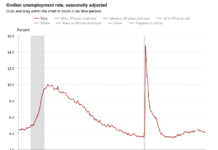

The US Bureau of Labor Statistics reports that US unemployment held steady at 4.4% in February 2026, with most states showing little change. Hawaii and South Dakota had the lowest rates, while the District of Columbia had the highest.
Employment was mostly stable nationwide, with small gains in California and Nevada and declines in a few states and D.C. The BLS writes:
Unemployment rates were higher in February in 1 state and stable in 49 states and the District of Columbia, the U.S. Bureau of Labor Statistics reported today. Thirteen states and the District had jobless rate increases from a year earlier, 2 states had decreases, and 35 states had little change. The national unemployment rate, 4.4 percent, changed little over the month but was 0.2 percentage point higher than in February 2025.
In February 2026, nonfarm payroll employment decreased in 2 states, increased in 1 state, and was essentially unchanged in 47 states and the District of Columbia. Over the year, nonfarm payroll employment decreased in 2 states and the District, increased in 2 states, and was essentially unchanged in 46 states.
This news release presents statistics from two monthly programs. The civilian labor force and unemployment data are modeled based largely on a survey of households. These data pertain to people by where they reside. The employment data are from an establishment survey that measures nonfarm employment, hours, and earnings by industry. These data pertain to jobs on payrolls defined by where the establishments are located. For more information about the concepts and statistical methodologies used by these two programs, see the Technical Note.
Unemployment
Hawaii and South Dakota had the lowest jobless rates in February, 2.3 percent each. The District of Columbia had the highest unemployment rate, 6.5 percent. The next highest rates were in California and Delaware, 5.4 percent each. In total, 21 states had unemployment rates lower than the U.S. figure of 4.4 percent, 6 states and the District had higher rates, and 23 states had rates that were not appreciably different from that of the nation.
In February, Florida had the only unemployment rate change (+0.1 percentage point). The remaining 49 states and the District of Columbia had jobless rates that were not notably different from those of a month earlier, though some had changes that were at least as large numerically as the significant change.
Thirteen states and the District of Columbia had unemployment rate increases from February 2025, the largest of which was in Delaware (+1.1 percentage points). The only over-the-year rate decreases occurred in Ohio (-0.7 percentage point) and Indiana (-0.5 point). Thirty-five states had jobless rates that were not notably different from those of a year earlier, though some had changes that were at least as large numerically as the significant changes.
Nonfarm Payroll Employment
In February 2026, nonfarm payroll employment decreased in 2 states, increased in 1 state, and was essentially unchanged in 47 states and the District of Columbia. Employment decreased in Illinois (-17,800, or -0.3 percent) and Nebraska (-6,500, or -0.6 percent). Employment increased in Arizona (+11,000, or +0.3 percent). (See tables D and 3.)
Over the year, nonfarm payroll employment decreased in 2 states and the District of Columbia, increased in 2 states, and was essentially unchanged in 46 states. Employment decreased in Maryland (-52,700, or -1.9 percent), the District (-42,200, or -5.5 percent), and Iowa (-19,200, or -1.2 percent). The job gains occurred in California (+120,500, or +0.7 percent) and Nevada (+34,500, or +2.2 percent).
The Metropolitan Area Employment and Unemployment news release for February is scheduled to be released on Wednesday, April 29, 2026, at 10:00 a.m. (ET). The State Employment and Unemployment news release for March is scheduled to be released on Wednesday, May 6, 2026, at 10:00 a.m. (ET).
Read more here.