

The US Energy Information Administration reports that in Q2 2025, energy markets saw high volatility due to global economic concerns and Middle East tensions. Brent crude dropped to $64/b before spiking to $79/b after Israel-Iran strikes, then settled at $68/b post-ceasefire. Diesel margins surged late in the quarter, while gasoline margins stayed near average. Biofuel credit (RIN) prices jumped over 35% amid regulatory shifts and higher 2026–2027 blending mandates. They write:
Energy prices—along with other globally traded commodities, equities, and currencies—were more volatile in the second quarter of 2025 (2Q25) amid significant uncertainty from concerns over economic growth as well as geopolitical tensions in the Middle East. The geopolitical uncertainty has affected crude oil prices and refinery margins, and shifting government policies have affected biofuel compliance credit prices.
Crude oil prices
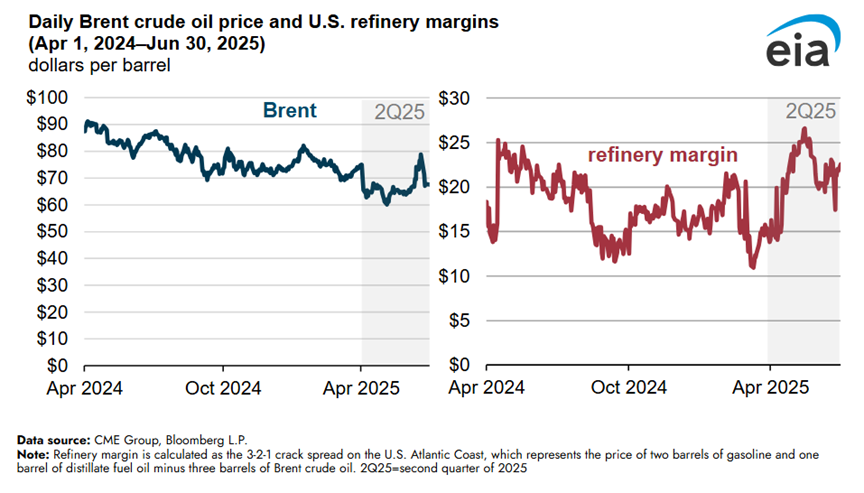
After adjusting for inflation, the Brent crude oil price decreased from nearly $75 per barrel (b) at the beginning of April to $64/b in June, the lowest since December 2020. A potential slowdown in global trade and business investment in the wake of escalating tariffs among large economies contributed to crude oil price declines. After Israel’s June 13 strikes on Iran, crude oil prices increased amid heightened oil supply risk with the threat of a disruption to regional crude oil production, an impact to nearby energy infrastructure, or a closure of the Strait of Hormuz. In the week from June 12 to June 19, the price of Brent crude oil spiked from $69/b to $79/b.Following U.S. strikes on Iran (June 21) and an Iranian response (June 23), a ceasefire between Iran and Israel was reached. With a ceasefire in place, the risk of a supply disruption in the Middle East decreased, and crude oil prices declined, ending the quarter at $68/b.
Since the end of 2Q25, prices have generally remained around $70/b because geopolitical tensions and the threat of supply disruptions are lower.
Refinery margins
Refinery operations in 2Q25 were characterized by relatively high refinery utilization as seasonal maintenance in most regions ended. Margins for gasoline (the difference between the wholesale price of gasoline and the price of crude oil) generally trended near or below the five-year average during this time as the higher utilization ensured the market was relatively well supplied, particularly at the end of June. Margins for diesel fuel, which are typically lower in the summer, surged near the end of June, reflecting high demand for distillate fuel in Europe amid rising geopolitical tensions in the Middle East.Historically, refinery utilization is highest in the summer as refiners maximize gasoline production to meet seasonal demand. Regional gasoline inventories on the East Coast, which is the largest U.S. gasoline market, have been higher this year than the last three years, suggesting the region is better supplied.
Margins for diesel were similarly at or below the five-year average for most of the second quarter. Geopolitical risks associated with the emerging conflict in the Middle East led to rapid increases in diesel margins after June 16. Above-average weekly distillate exports have contributed to lower inventories and have supported higher diesel margins.
Biofuel compliance credit prices
Volatility in the price of renewable identification number (RIN) credits in 2Q25 largely reflected news related to the Renewable Fuel Standard (RFS), and the average price for RINs increased in 2Q25 compared with 1Q25. RINs are the compliance mechanism used for the RFS program administered by the U.S. Environmental Protection Agency (EPA).Prices began 2Q25 elevated, driven by expectations of an increased RFS blending mandate in 2026 following industry discussions in March among oil and biofuel producers. RIN prices retreated beginning in late-May because of both possible small refinery exemptions that could effectively lower blending mandates and rumors that the EPA may propose lower blending mandates than previously expected. Prices then sharply increased in mid-June upon the release of the proposed RFS rule for 2026 and 2027, which increased blending mandates and proposed regulatory changes to reduce RIN generation from imported biofuels and feedstocks.
The average prices for biomass-based diesel (D4) and ethanol (D6) RINs increased by more than 35% in 2Q25 compared with 1Q25.


Read more here.