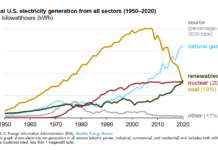

The US Energy Information Administration reports that in 2024, U.S. energy consumption increased to approximately 94 quadrillion British thermal units, a 1% rise from 2023. Fossil fuels still dominated, making up 82% of total use, while renewables and nuclear energy accounted for 18%. Petroleum remained the top energy source, followed by natural gas. Notably, nuclear energy surpassed coal consumption for the first time. Wind and solar usage also continued to grow, with renewables now outpacing coal and nuclear energy. This marks a significant shift in the U.S. energy landscape, which has evolved from wood and coal in the 18th and 19th centuries to a more diverse mix today. The EIA writes:
In 2024, the United States consumed about 94 quadrillion British thermal units (quads) of energy, a 1% increase from 2023, according to our Monthly Energy Review. Fossil fuels—petroleum, natural gas, and coal—accounted for 82% of total U.S. energy consumption in 2024. Nonfossil fuel energy—from renewables and nuclear energy—accounted for the other 18%. Petroleum remained the most-consumed fuel in the United States, as it has been for the past 75 years, and nuclear energy consumption exceeded coal consumption for the first time ever.
When the Declaration of Independence was signed in 1776, wood, a renewable energy source, was the largest source of energy in the United States. Used for heating, cooking, and lighting, wood remained the largest U.S. energy source until the late 1800s, when coal consumption became more common. Wood energy is still consumed, mainly by industrial lumber and paper plants that burn excess wood waste to generate electricity.
Coal was the largest source of U.S. energy for about 65 years, from 1885 until 1950. Early uses of coal included many purposes that are no longer common, such as in stoves for home heating and in engines for trains and ships. Since the 1960s, nearly all coal consumed in the United States has been for electricity generation.
Petroleum has been the most-consumed source of energy in the United States since 1950. Petroleum products such as motor gasoline, diesel, jet fuel, and propane are commonly used across all sectors of the U.S. economy, from transportation to industrial chemicals and plastics.
Natural gas is the second-largest source of U.S. energy consumption, as it has been most years since it surpassed coal in 1958. Natural gas was once considered a waste byproduct of crude oil production but now has become a common energy source for heating and electricity generation.
Early use of water to power grist, lumber, and other milling operations is not well quantified and not included in our data, but such mills were common throughout early U.S. history. The first industrial use of hydropower to generate electricity in the United States was to power lamps at a chair factory in Grand Rapids, Michigan, in 1880. The world’s first hydroelectric power plant to sell electricity to the public opened on the Fox River near Appleton, Wisconsin, in 1882.
Other forms of renewable energy did not become significant contributors to U.S. energy production until more recently. In 2016, biofuels—including the fuel ethanol mixed in motor gasoline—became the most-consumed U.S. renewable energy source.
Electricity generation from some zero-carbon sources, such as wind and solar, has increased rapidly in recent years, while generation from others, such as hydropower and nuclear, has remained relatively flat. In 2022, U.S. energy consumption from renewable sources surpassed nuclear energy for the first time since 1984, and in 2023, renewables surpassed coal for the first time since around the early 1880s. The United States now consumes more energy from wind and solar sources individually than from hydropower.
To compare different forms of energy, we convert to common units of heat, called British thermal units. Appendix A of our Monthly Energy Review has the conversion factors that we use for each energy source, and Appendix E explains how we convert noncombustible renewable energy sources.


Read more here.