
Are you familiar with the Efficient Frontier (EF) and the arithmetic of losses? As I wrote to you yesterday, over the weekend, I had the pleasure of studying a classic issue of Richard C. Young’s Intelligence Report. Your Survival Guy and Gal were at my parents’ house in Mattapoisett, MA, staying in their guest room, and as I was thumbing through a book, out fell the issue from August 2015. I put it aside to read in the morning.
Earlier in the day, Your Survival Guy drove from Newport to Marion, MA, to meet friends from high school who live locally and another who was back in town from Durham, NC. It’s not every day that you get a round of golf in at the Kittansett Golf Club in Marion, MA, with your best friends.
It’s been 38-years now since the four of us have played our “annual” match, with each feeling like it was just yesterday when we last played together. Your Survival Guy and partner were out of it with three to play. There’s always next year.
Later, we all met up at the Mattapoisett Inn, or The Inn as it’s now called, an institution overlooking Mattapoisett Harbor, to meet up with the rest of the local gang and spouses.
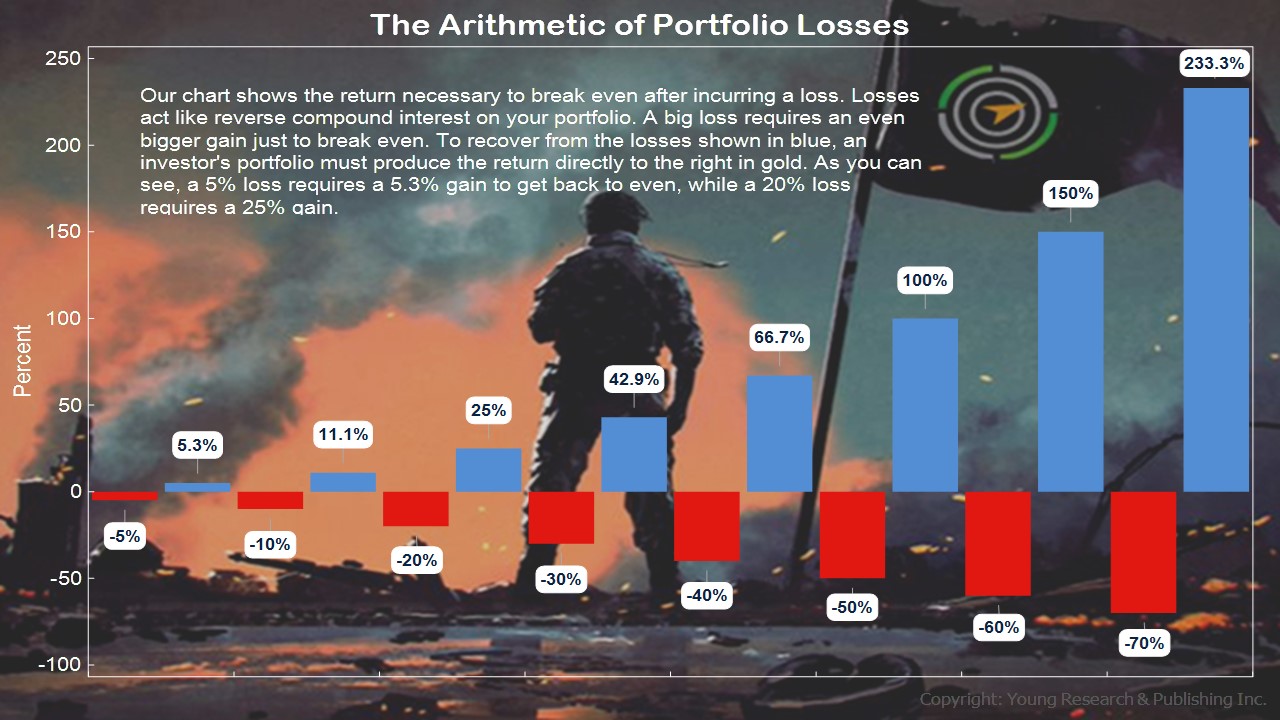
Life comes at you fast. And when it comes to money, as we get older, we have more to lose. That’s not supposed to be a sad comment; it’s just the reality of putting one foot in front of the other and compounding good decisions. It’s why when it comes to your investments, the closer you get to retirement or when you’re in retirement, the better it is to understand the efficient frontier and the arithmetic of losses.
 The Efficient Frontier, created by Harry Markowitz in 1952, measures the efficient diversification of investments that delivers the highest level of return at the lowest possible risk. Investors must consider the trade-offs between risk and reward in their portfolios. You can see on the chart above an efficient frontier line representing risk vs. reward for a portfolio allocated between different proportions of stocks and bonds using data back to 2000.
On the vertical axis is the return earned by the portfolios, and along the horizontal axis is a measure of how much risk was taken to earn those returns. As you can see by comparing the portfolio of 80% bonds and 20% stocks to the portfolio of just bonds, as portfolios take on a small number of stocks, the benefit of diversification lowers risk and increases reward. Anything above the line is unachievable because no portfolios earning those returns are available at the corresponding risk levels. And any portfolios that fall below the line can be outperformed with the same amount of risk or have their returns matched with less risk.
But to achieve higher returns along the line, investors adding more stocks to their portfolios are taking on ever greater amounts of risk. A portfolio of 100% stocks boasts a standard deviation of over 14%. Be aware of the risk in your portfolio and manage it wisely.
Action Line: Did you see the U.S. Open Sunday? Never give up. Stick to your game. Good things may happen. When you want to talk about your plan for retirement, email me at ejsmith@yoursurvivalguy.com. And click here to subscribe to my free Survive & Thrive letter.
Originally posted on Your Survival Guy.