
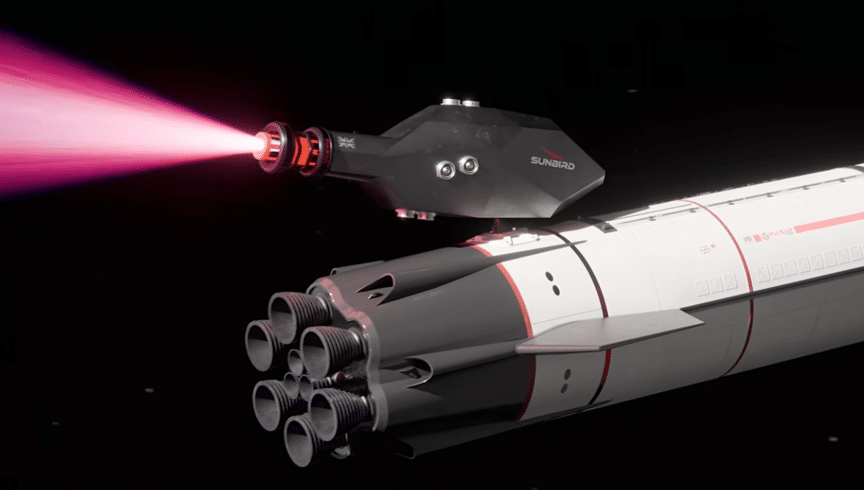
Pulsar Fusion’s Sunbird is a proposed reusable, fusion-powered spacecraft designed to transport satellites, cargo, and scientific payloads across the solar system. Founder Richard Dinan presented the vehicle, which aims to combine high thrust with extremely high exhaust velocity, potentially enabling faster journeys to Mars and the outer solar system. Its planned Dual Direct Fusion Drive is projected to deliver up to 2 megawatts of power, with a potential four-year journey to Pluto for a 1,000-kilogram spacecraft. These capabilities remain theoretical until the complete propulsion system is demonstrated.
In March 2026, Pulsar achieved first plasma in its Mark I Sunbird exhaust test system at its Bletchley facility in the UK, demonstrating initial plasma confinement using electric and magnetic fields. Further testing will explore advanced superconducting magnets, plasma heating, and measurements of thrust and exhaust velocity. Pulsar is also working with the UK Atomic Energy Authority (UKAEA) to study radiation damage and improve reactor durability.
Pulsar aims to demonstrate core Sunbird technology in orbit in 2027. The company is also collaborating with the UK Atomic Energy Authority (UKAEA) to investigate how neutron radiation affects reactor walls and magnets, a key challenge for the durability of fusion systems. If successful, Sunbird could support faster planetary exploration and future space infrastructure, although its projected performance and mission timelines depend on overcoming significant technical and engineering challenges.