

Dear Survivor,
When you live on a fixed income, it’s a terrifying moment when you wonder if you’ll have enough money for the rest of your life. What’s even more frightening is the day you retire and the years leading up to it, when you can’t stop wondering, “Will I have enough?”
What should you do? Do you work longer? Can you retire now? What will it feel like to no longer have a paycheck? And this is supposed to be a celebration? “Somebody help me,” you think.
Don’t get me wrong, retirement life is fun. I know this because you tell me while I’m stuck at my desk. That’s OK. That’s the way it should be. Retirement life is fun when your worries are about what you’re going to be doing next and how busy you are.
What you want to try to avoid is falling for the “can’t miss opportunities” friends may tell you about or the advertisements by former pro-athletes selling you money “opportunities.” The fact that they’re “investors too” doesn’t make me any more comfortable with their proposals.
But sometimes, hopefully not you, money decisions rewire people’s brains. It’s like a switch is flipped and they become believers—believers in stuff you’d never touch if your life depended upon it.
That’s life.
It’s not just important to “have enough.” It’s also important to be prudent with your money, and for those helping you with your money to exercise prudence. That’s the Prudent Man. In the September 2015 issue of Richard C. Young’s Intelligence Report, Dick Young wrote:
The Prudent Man Rule is based on common law stemming from the 1830 Massachusetts court formulation Harvard College v. Amory. The Prudent Man Rule directs trustees “to observe how men of prudence, discretion and intelligence manage their own affairs, not in regard to speculation, but in regard to the permanent disposition of their funds, considering the probable income, as well as the probable safety of the capital invested.”
Since I started our family investment management firm in 1989, I have operated under the assumption that the Prudent Man Rule to this day carries as much weight as it did in 1830. Common sense and prudence just don’t go out of style—ever.
Who Helps You Get Out of the House?
When you think about how you got to where you are with your investments, you can probably tick off a few names who helped you along the way: your parents, your grandparents, or someone else like Richard C. Young, who taught you, or them, how to invest.
In my conversations with you, it’s not uncommon to hear: “My dad followed Richard Young for years and turned me on to him.”
What made Richard C. Young’s Intelligence Report effective was that you knew if you didn’t act on his ideas this month, you’d feel like you missed the boat the following issue.
Every month, he offered his best ideas, and it was up to you to put them to work in your portfolio. It’s why readers enjoyed his introduction so much, because you knew the homework section hadn’t quite started yet. Who doesn’t love recess?
But life can’t always be about recess. We all need a little help to get us going and to keep us going.
It’s why when you have others depending on you to show up, whether it is at the golf course, the pickleball court, your book club, or the gym, you feel a little pressure to be there.
That’s not a bad thing. It helps you take action, and often you feel better for having done it. Not always, but mostly.
“What Do YOU Think?”
“What do YOU think?” asked my client in an email regarding the recent op-ed by Robert Pozen in The Wall Street Journal titled, “You’re Probably Overinvested in Bonds.”
“He may be right,” I said. “But I think he’s wrong.”
The case Mr. Pozen makes is that stocks will outperform bonds and that the proper allocation is not the typical 60% in stocks and 40% bonds or a 60-40 portfolio, but rather, it should be 90% stocks and 10% bonds.
Sure, as Mr. Pozen explains, stocks have outperformed bonds over several time periods. But it’s the few major hits that have Your Survival Guy questioning his advice. Because I’ve been in the trenches with boots on the ground, fielding calls from retired investors during some of the worst markets this century. It’s not pretty.
I can tell you, from my unique perspective, that when times are tough, retirees do not care about “what stocks have done for the long-term or how they might recover.” What they care about is how much money they’re losing every day and how much longer it will go on for. They don’t have the luxury of time to “ride it out” when their spouse is asking them nightly, “How is our money doing?”
To be fair: “Plenty of people should hold bonds,” writes Mr. Pozen. “If you are retired and subsisting on your investment income, or if you would have to sell a significant chunk of your investments to cover living expenses in a bad year, you should have more in high quality bonds.”
I agree. But what about all those retirees who have IRAs that are required to take an RMD (required minimum distribution) and have 90% in stocks and the market crashes? The RMD is calculated on the prior year’s year-end balance, and the withdrawal amount may be a lot higher percentage of the account after the crash. It’s my belief that a more balanced portfolio, say 60-40, may help lessen the damage of a required distribution during a bad year for stocks.
I’ll also make the point here that $1 million isn’t what it used to be, especially with government in the business of inflation, creating more dollars to inflate away the debt. That $1 million will not go as far tomorrow as it does today. Which is why I believe investors need to be defensive in their portfolio allocations even if they have enough income coming in outside of it. Because there may be a time when the math changes and they’ll need to tap into their $1 million nest egg.
In reading House of Fidelity: The Rise of the Johnson Dynasty and the Company that Changes American Investing, by Just Baer, you’ll learn how Mr. Pozen was hired as Fidelity’s general counsel, emerging as a key executive to Ned Johnson, during the 1990s. There’s a section in the book where, after the Go-Go 1960s, stocks went into a deep freeze. A time when Mr. Johnson needed to find ways to diversify the business, seeking other sources of revenue. When asked about this difficult time and what it was like, he remarks that he’s not sure he would have stayed in the business had he known it was going to last that long.
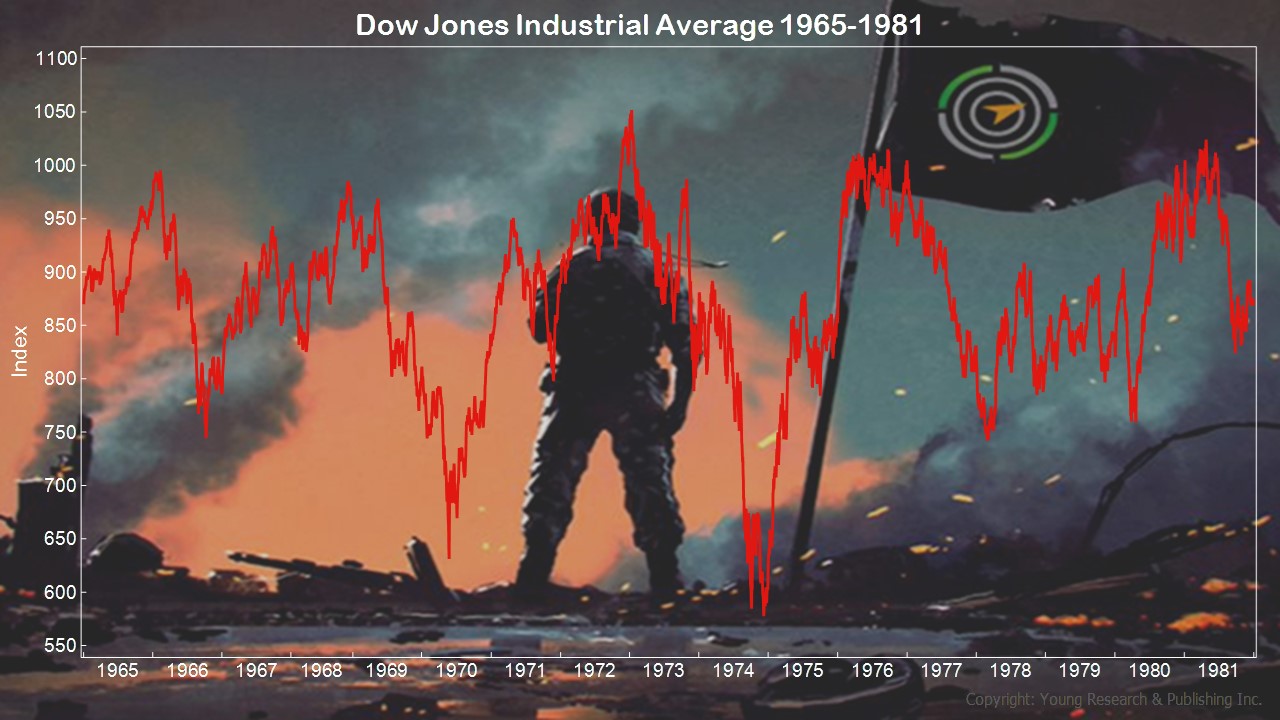
That doesn’t mean you load up on bonds. It just means you want to become a student of prices. As Ben Graham points out in The Intelligent Investor, you want to consider a 50-50 portfolio when stocks are richly priced, so you’re not making a prediction, and he suggests keeping within the parameters of 70-30 or 30-70 portfolio.
Developing the right asset mix is more art than science. It’s more about understanding you. It’s not a one size fits all. When you want to talk about your situation, let’s talk. Email me at ejsmith@yoursurvivalguy.com.
Survive and Thrive this month.
Warm regards,

“Your Survival Guy”
- If someone forwarded this to you, and you want to learn more about Your Survival Guy, read about me here.
- If you would like to contact me and receive a response, please email me at ejsmith@yoursurvivalguy.com.
- Would you like to receive an email alert letting you know when Survive and Thrive is published each month? You can subscribe to my free email here.
P.S. Your Survival Guy’s boat, Tom Sawyer, is in the water and will be ready to go after I load up more gear. It’s chilly this morning, 50 degrees at my house, which means it will feel much colder down on the dock and out on the water.

Funny, it was in the low 70s on Wednesday, which is unusual for this time of year. It was a long, cold winter. It will take a little longer for the water to warm up. But I’m excited for the season.
One exercise I perform at the beginning of every season is to think about how well prepared I am if something goes wrong. I always consider myself a boater first, the captain if you will, and then a fisherman or harbor tour guide, for example. Not the other way around. I tell my family, you need to be a boater first, and then you can enjoy whatever activity you’re doing.
Before we leave the dock, I always get my guests familiar with the vessel so they understand the seriousness of what we’re doing. “Here’s the man overboard throw bag,” for example. I show them where the lifejackets are, the first aid kit, VHF after doing a radio check, kill switch for the engines, and other essentials. Before we shove off, I tell them not to worry about fending off if I get too close or bump into another boat. “It’s only a boat,” I tell them.
As a rule of thumb, if the weather is iffy at the dock, it will be more than iffy away from the dock. Which is why if it’s a tough call to stay tied up rather than “go for it,” I stay tied up. It’s always the right call, even if I know “we could do it.” Peace of mind and comfort aren’t just for investing.
P.P.S. Your Survival Guy had the pleasure of playing in a member/guest golf outing recently. In between shots, my host and I were talking about residential real estate prices. Both of us have kids in their twenties, and the focus was more about how their generation deals with affordability. Which got us thinking: How did we afford it? Good question.
When you start thinking about what may be perhaps one of your most valuable assets, getting in the game matters, and it’s a leap of faith. When we found our first home in Newport, Rhode Island, I remember my father (who was a realtor) couldn’t believe what it was going to cost—not the vote of confidence we were looking for, but we bit the bullet and bought it anyway.
During the financial crisis ten years later, it wasn’t like we were going to pack up the house and kids and move. We were not selling. We just kept making payments and living our lives as young parents.
Today, we live in a different house, but when I walk down memory lane and go to Zillow to see what that same house would go for today, it’s five times as much as what we paid back in 1998. In other words, if you wait too long for prices to come down, it may be a long wait before you’re a homeowner.
What’s even more important is the financial discipline you’re forced to learn at a young age. Getting into the game, doing the work, makes for some long days. But looking back, I’m happy we got into the game and made (not hoped) the numbers work.
P.P.S. Your Survival Guy and Gal were at Babson College recently for our son’s graduation. It felt like yesterday we were dropping him off for freshman orientation. I remember the emotions that day as we pulled out of campus and felt them all over again. He was leaving for the last time as a student, something his mom and I did after graduating in 1994.

You worry as a new grad. What will life be like? They don’t teach you how to survive and thrive in finding a roommate and an apartment. How to afford grocery shopping for healthy food, or any of the other parts of life that we all are hopefully getting better at by now. It’s hard to get your bearings.
And we all know that different stages call for different skills. And that the hard things we do feel pretty good when they’re to our stern. Happy that we got through. Not sure we’d want to do it again. We never stop having those experiences and challenges in life, no matter how old we are. We just push forward and believe we have what it takes to carry on. Something I believe you have.
Congratulations.
I hope someone you love is graduating this spring, and how fortunate they are to have you in their life. Keep me posted. Email at ejsmith@yoursurvivalguy.com. If you know a recent graduate or someone in college today, send them a copy of my free Special Report: How to Invest After Graduating College.

Download this post as a PDF by clicking here.
Originally posted on Your Survival Guy.