
In a time dominated with news on the fate of Obamacare and any potential replacement, Dan Mitchell of the Cato Institute keenly refocuses attention on what is the world’s biggest government program, and one that is headed for a fiscal train wreck: Social Security.
The program will soon have an annual budget of $1 trillion, a budget larger than that of all but six countries on earth.
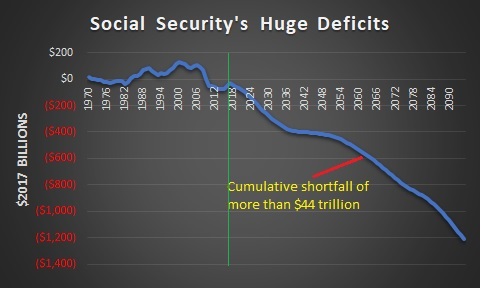
But Dan points out the scary fact that the program will have a shortfall of $44.2 trillion between now and 2095. He writes:
And for those who want to know about the gap between the inflow and outflow, here’s a chart showing how deficits are going to explode in coming decades. Again, keep in mind these are inflation-adjusted numbers.
That’s not a typo in the chart. The total shortfall between now and 2095 is a staggering $44.2 trillion. Yes, trillion.
Remarkably, there’s an even bigger long-run problem with Medicare and Medicaid. Which helps to explain I relentlessly push for genuine entitlement reform.
But let’s focus today on Social Security. The answer to this looming fiscal nightmare is to copy one of the many nations that have shifted to “funded” retirement systems based on real savings. I’m a big fan of the Australian approach. Chile also has a great system, and Switzerland and the Netherlands are good role models as well. Hong Kong and Singapore also rely on private savings for retirement, and both jurisdictions demonstrate that aging populations and falling birthrates aren’t necessarily a fiscal death sentence. Heck, even the Faroe Islands and Sweden have jumped on the bandwagon of private retirement accounts.
Read more here.