At MarketWatch, Christine Idzelis reports that Morgan Stanley analysts are raising the alarm over increased market fragility. She writes:
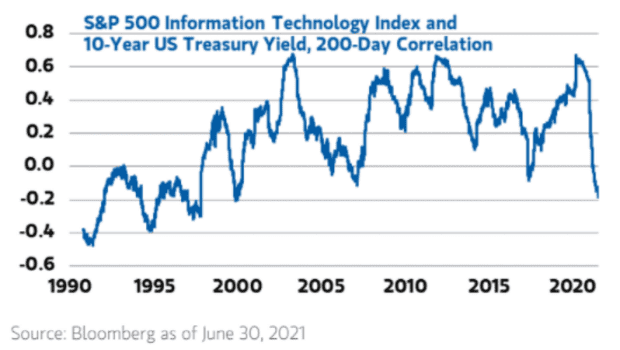
The relationship between high-flying technology stocks and U.S. Treasury yields has broken down, echoing ‘the extreme anomalies of the dot-com boom when tech valuations became unmoored,” according to Morgan Stanley.
“For most of the last 20 years, tech stocks have traded directionally with economic growth—carrying a positive correlation with long-duration Treasury yields—as investors viewed them as tied to positive economic growth,” Lisa Shalett, chief investment officer of Morgan Stanley’s wealth management business, said in a report this week. Now “bountiful liquidity” is distorting both interest rates and tech stocks, which are now negatively correlated at the lowest level since 2000, when the market saw an internet stock bubble.
This chart in Morgan Stanley’s report shows the relationship between the S&P 500 Information Technology Index and 10-Year U.S. Treasury yields since 1990.
“With tech trading at a 60% premium to an already expensive market, interest rate sensitivity is once again negative, suggesting any backup in yields will be a powerful headwind,” Shalett said in the report. “This index concentration in tech stocks increases market fragility.”
Major U.S. stock benchmarks — the S&P 500 SPX, 0.81%, Dow Jones Industrial Average DJIA, 1.09% and the tech-heavy Nasdaq Composite COMP, 0.40% — have risen this year to a series of new records. Information technology is the largest sector in the S&P 500 index, FactSet data show.
“The second quarter closed with growth-dominated U.S. stock indexes at all-time highs and up more than 14% for the year to date, while value and cyclical stocks lagged despite forecasts for near 10% nominal GDP growth this year,” Shalett said in the report. “This dynamic may be explained by the 30-basis-point pullback in the 10-year US Treasury yield and a hawkish tilt by the Federal Reserve.”