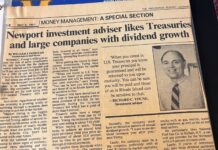
In October of 1999 I explained why there is only one right way to save; early and often. I wrote:
Compound Interest: Your Key to Wealth
Here’s an example of the power of compound interest that I hope you will pass on to your children and grandchildren.
We have two hypothetical investors, Chad and Tad. Chad starts right out of his MBA program investing $1,200 a year starting at age 25 through the time he is 32-years old. He makes eight $1,200 investments. Chad then oddly becomes a monk, ending his savings days. Assume just a modest 9% annual return through age 64, just pre Chad’s 65-year age retirement from monkdom. Chad’s eight years of savings ($9,600) and 40 years of compounded interest provide a final balance of $227,390.
Tad, on the other hand, spends his early years as a ski bum in Telluride and doesn’t start saving until he is 33. But from age 33 until age 65, Tad is able to save $1,200 a year from his job as wildlife conservationist in the remote reaches of Montana. He puts away $1,200 a year for 32 years, giving him a total savings of $38,400—four times the contributions Chad made in only eight years of savings before monkdom. Tad’s balance at the same 9% assumed growth rate is $214,560. Even though Chad invested $1,200 a year for only eight years early in his “career,” because of 40 years of compound interest, Chad’s final savings total beat Tad’s, who diligently socked away the same $1,200 a year, but for a long 32 years.
Such is the power of compound interest. Save early. Save often. And do not compromise your capital. When you lose 50%, you must make 100% on your next investment just to get even. And at that, you have a zero return. That’s stinko math in my book.
So after just eight years of early saving, Chad used compounding to save himself more than Tad could in 32 years of trying to play catch up. Put the power of compounding to work in your portfolio. Investing in companies with generous dividends, and records of regularly increasing those dividends is a bedrock strategy of my family run investment counsel firm.
If you would like to discuss how a dividend-centric investment plan could work for your retirement, please fill out the form below. You will be contacted by a seasoned advisor from Richard C. Young & Co., Ltd. and given a free, no-obligation portfolio review.
Originally posted on Young’s World Money Forecast.