
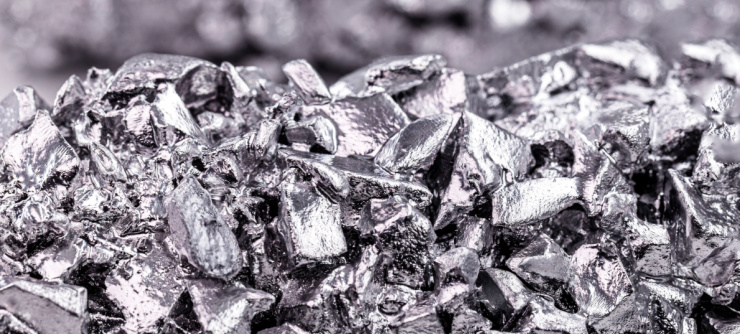
On his Substack, Construction Physics, Brian Potter discusses the history, importance, and uses of titanium. He writes:
The earth contains a lot of titanium – it’s the ninth most abundant element in the earth’s crust. By mass, there’s more titanium in the earth’s crust than carbon by a factor of nearly 30, and more titanium than copper by a factor of nearly 100.
But despite its abundance, it’s only recently that civilization has been able to use titanium as a metal (titanium dioxide has been in use somewhat longer as a paint pigment). Because titanium so readily bonds with oxygen and other elements, it doesn’t occur at all in metallic form in nature. One engineer described titanium as a “streetwalker,” because it will pick up anything and everything. While copper has been used by civilization since 7000 BC, and iron since around 3000 BC, titanium wasn’t discovered until the late 1700s, and wasn’t produced in metallic form until the late 19th century. As late as 1945, there was no commercial production of titanium, and the metal only existed in tiny amounts in labs. But less than 10 years later, thousands of tons of it were being made a year. And 10 years after that, it formed the literal backbone of the most advanced aerospace technology on the planet.
As a report to the National Research Council notes, “the birth of a tonnage structural metal industry is an unusual event. Only three such births have occurred in the past 100 years [now closer to 150] – aluminum, magnesium, and titanium – and no new one is in prospect.” How did titanium go from totally unused to a critical aerospace technology? What does it tell us about technological development? Let’s take a look.
Read more here.