
While there are aspects of nearly every job that might be improved on or automated by artificial intelligence, there are some careers in which humans are harder to replace than others. Your Survival Guy is a huge fan of nursing as a career choice. Demographics don’t lie. America needs nurses. Jeanne Whalen explains in The Wall Street Journal that healthcare jobs have become the “surest bet” to a middle-class life in America. She writes:
Factory work used to be Americans’ most reliable ticket to the middle class. Office jobs offered another dependable route. But as automation, globalized manufacturing, and now artificial intelligence threaten or narrow some of these paths, healthcare jobs have become the surest bet. At a time of uncertainty in the labor market, nursing offers not only stability but, for some, a pathway to real prosperity.
The median annual wage for registered nurses in the U.S. is $93,600, compared with $49,500 for all occupations, according to the Labor Department. For nurse practitioners and others with advanced degrees, it is $132,050.
Nursing shortages are projected for years. The National Center for Health Workforce Analysis (Did you know we had one of those?) projects nursing shortages until 2038. The NCHWA explained in December:
Nurse Workforce Projections, 2023-2038
December 2025
This brief contains highlights of workforce projections for the nursing workforce in the United States.
These estimates were generated using HRSA’sHealth Workforce Simulation Model (HWSM) and start with the year 2023 and go through 2038. The primary function of the HWSM is to assess the adequacy of the nation’s projected workforce supply to meet the demand.1 Full data on the workforce projections are available in the Workforce Projections Dashboard.
Key Results and Takeaways
These projections were generated using historical data up to and including some data from 2023. Data are shown at 5-year intervals (2028, 2033, and 2038) throughout this analysis.
- At the national level, there are shortages projected until 2038. Specifically, there is a
projected 8% shortage of registered nurses (RNs) in 2028. By 2038, the shortage is 3% (a shortage of 108,960 full-time equivalent [FTE] RNs). See Exhibits 1a-1c.2 These projections assume that historical patterns of attrition, graduation, and labor force participation remain the same over the forecast period.3- Nonmetro areas are projected to have a higher shortage of RNs than metro areas in each of the three interval years: 11% vs 2% in 2038, 18% vs 4% in 2033, and 24% vs 5% in 2028.
- The demand for licensed practical and vocational nurses (LPNs) is projected to grow faster than supply between 2023 and 2038, resulting in a projected shortage (245,950 LPN FTEs) in 2038. Nationwide, the projected supply of LPNs in 2038 is sufficient to meet just 70% of the demand for LPNs, compared to 83% in 2028. See Exhibits 1a-1c.
- At the national level, the supply of nurse practitioners (NPs) is projected to exceed demand over the projection period; however, distribution remains the most important issue.
- Despite national shortages of RNs and LPNs, significant geographic maldistribution remains a large issue for the nursing profession. Projected supply adequacy of RNs varies considerably across states, ranging from a shortage of 22% in California to a projected 79% oversupply in Wyoming in 2038.
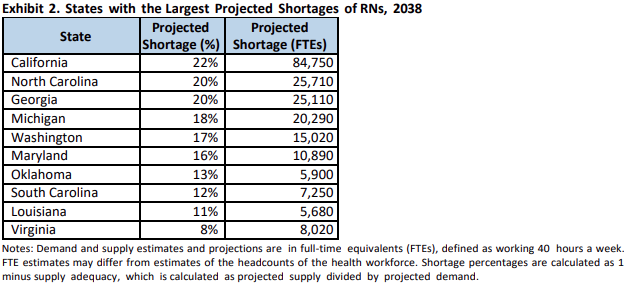
- The ten states with the largest projected RN shortages in 2038 are: California (22%), North Carolina (20%), Georgia (20%), Michigan (18%), Washington (17%), Maryland (16%), Oklahoma (13%), South Carolina (12%), Louisiana (11%) and Virginia (8%).4 See Exhibit 2.
- As with RNs, the projected adequacy of supply for LPNs varies considerably across states, ranging from 21% (a 79% shortage) in Alaska to 139% (a 39% oversupply) in Oklahoma in 2038.

Action Line: As you can see, with the Baby Boomers aging, America needs healthcare workers. Students looking to find jobs resistant to AI replacement would do well to explore the healthcare industry. And once they graduate and begin earning good money, they should begin to save til it hurts. If you know a graduating nurse or any young person who needs help getting started investing, click here to download a copy of my free Special Report: How To Invest After Graduating College to give to them today.
Originally posted on Your Survival Guy.