What if there were a way for you to own income-generating securities without having to earn the money to buy them? What if you were able to generate billions in profits from this “free” portfolio? That’s exactly what the Federal Reserve is doing, and it’s passing those profits along to the U.S. Treasury.
The Fed paid $76.9 billion to the Treasury in 2011. That’s enough to fund the Department of Commerce, Department of the Interior, Corporation for National Community Service, Small Business Administration, National Science Foundation, EPA, Corps of Engineers, and NASA in 2012 and still have $3 billion left over to fund foreign governments the U.S. will help topple next year.
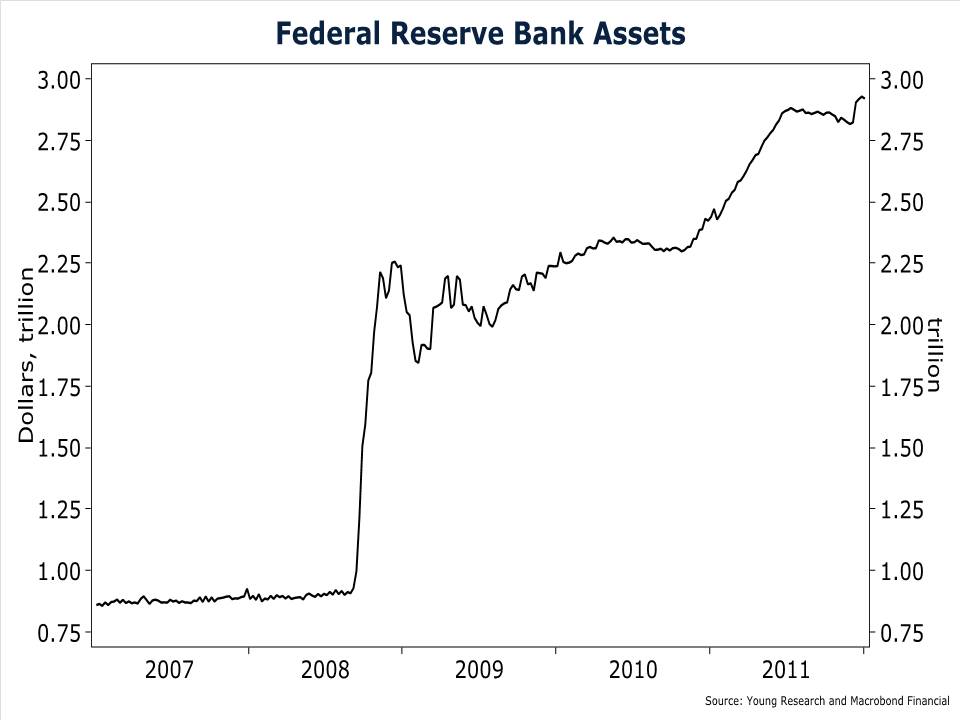
How is it possible? The Fed’s electronic printing press makes it so. In response to the financial crisis and the following economic malaise, the Fed fired up the digital dollar machine to accumulate its very own endowment of $2.92 trillion. The mortgage-backed securities and Treasury bonds on the Fed’s balance sheet all generate income, and after the banks that own the Fed take their 6% dividend and expenses are paid at the Fed, the profits go to Uncle Sam.
Take a look at my chart of the assets on the Fed’s balance sheet. Back when the Fed had only around $875 billion on its balance sheet, it was generating around $30 billion in income for the federal government. But look at the increase in assets in 2008, and the continued climb since. The Fed is nearly at $3 trillion with no end in sight. With the Fed now sending nearly $80 billion to the Treasury every year, it’s starting to look like real money. Congress doesn’t like to see revenue streams disappear. The increase of the Fed’s dividend to the Treasury added $50 billion a year to federal receipts. Eliminating that would be similar to an approximately 25% reduction in corporate income tax revenues.
Now officials at the Fed are calling to expand the balance sheet even further. Federal Reserve Bank of San Francisco President John Williams said yesterday that he sees a “strong” case for more Federal Reserve purchases of mortgage bonds. New York Federal Reserve President and FOMC Vice-Chairman William Dudley recommended “additional housing policy interventions” last week.
If the Fed’s balance sheet continues to grow, and continues to fund more and more of the nation’s expenses, how easy will it be in the future for the Fed to decrease the size of its balance sheet without political backlash? Congress is known for becoming dependent on temporary streams of revenue for long periods of time. For example, the estate tax and the gift tax were thought to be “temporary” when legislated in 1916. They have been with us since (barring a brief respite for the estate tax in 2010).
Don’t sit on the edge of your seat waiting for the Federal Reserve to trim its balance sheet. The Fed has created a de facto sovereign wealth fund, and Congress won’t want to see it liquidated.