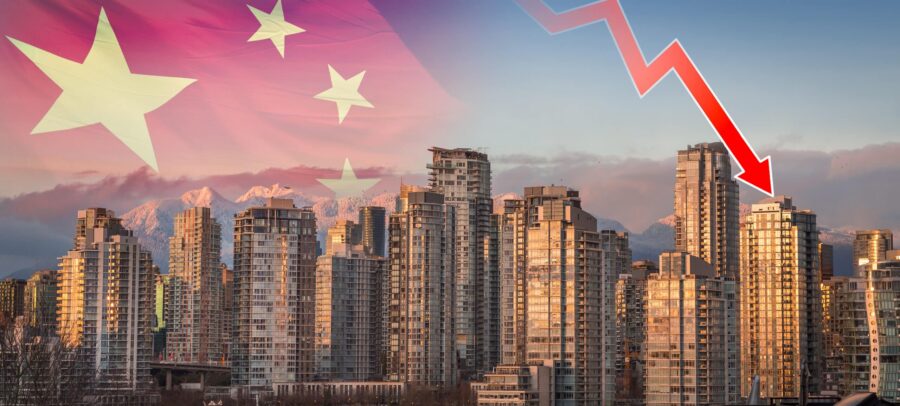
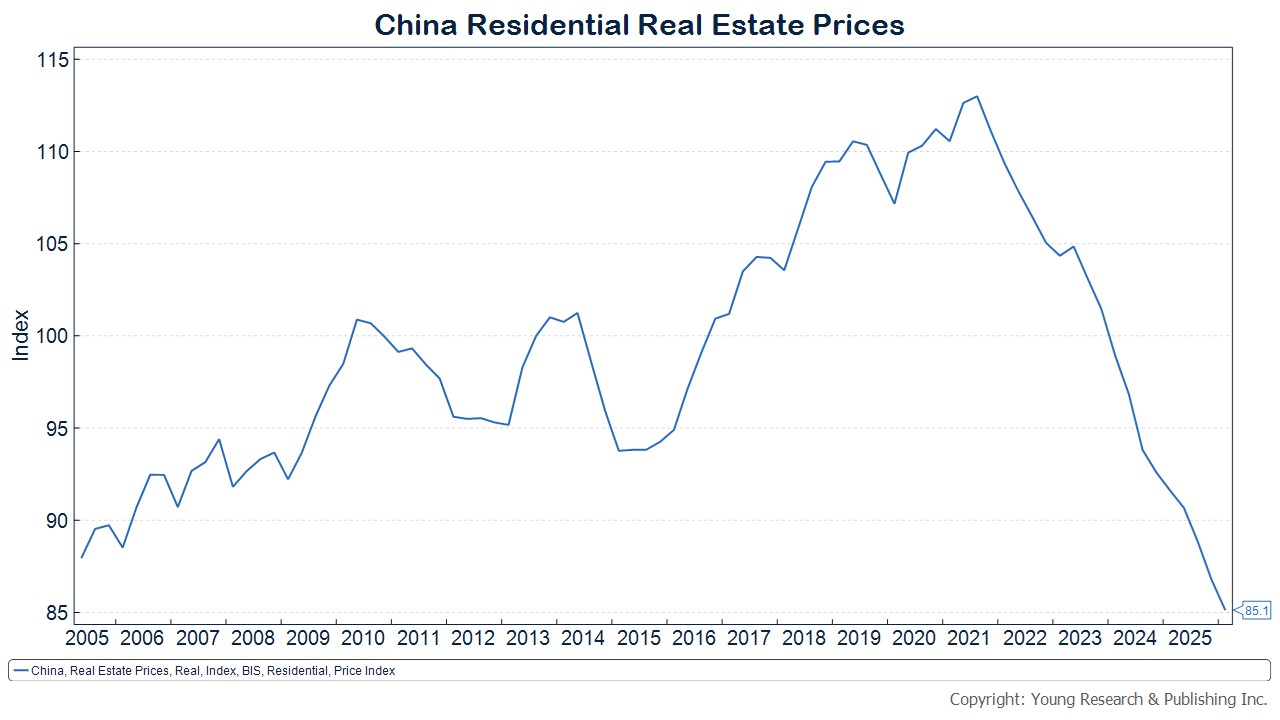
You may remember my warnings in 2012 against direct investment in China. I thought then that the country’s numbers looked funny, and that it didn’t play by the rules. One issue I singled out in particular was China’s investments in “Ghost Cities,” which seemed like a real scam. Since then, Evergrande, one of China’s largest developers, has been dissolved, and prices for Chinese residential properties have fallen back below 2005 levels (in real terms).
I wrote back in 2012:
I have long advised against direct investment in China. Among the many reasons I am bearish on China is the country’s vastly distorted economy. China is a command style economy run by an unelected political party—the Communist Party of China (CPC). The CPC’s policies have resulted in a grand misallocation of capital. A mercantilist cur rency policy, perverse incentives for provincial gov ernment officials, and crude monetary policy tools have helped inflate a fixed asset and real estate bub ble that puts the U.S. real estate bubble to shame.
A Quality Problem
It should be obvious to most that things are not as they seem in China. China has reported GDP growth of 9% or more in every quarter over the last two years, but the Shanghai Composite Stock Index has plunged more than 30% during that time. If China’s economy were truly booming, Chinese shares would most likely be trending up. China suffers not from a quantity of economic growth problem, but a quality growth problem. China’s GDP statistics are being propped up by unproduc tive fixed asset investment. The real estate sector is the most obvious example. To prop up GDP growth rates the Chinese are building entire cities, but they are virtually empty. For more on these ghost cities, be sure to check out the China’s Empty Cities video at www.youngresearch.com.
It is perplexing that the world has allowed a command style economy run by an unelected politi cal party to become such an important player in the global economy. China is now the world’s second largest economy and America’s second-largest trad ing partner. If China heads into the tank, the world economy will suffer.
China doesn’t play by the same rules or have the same motives as the world’s other large economies. China has consistently manipulated its currency to gain export market share and it has subsidized favored industries through its financial system to the detriment of non-Chinese companies. Take the rare earths industry as an example. China now has an effective monopoly on rare earths production. Not because of the country’s low labor costs or a lack of reserves in other countries, but because Chinese rare earths companies were provided with subsidized loans. Rare earths companies ramped up produc tion in the ’80s and ’90s and drove prices down to unprofitable levels. The Chinese government was more interested in maintaining stability through high employment then, as they are today. Low prices pushed rare earths producers in the U.S., Australia, and elsewhere out of business. With the support of subsidized loans, China’s rare earths companies were the only companies able to remain in business at such low prices. Now the U.S. relies on China (at least temporarily) for a supply of metals vital to the defense industry and other high-technology industries. Sound like a smart strategy to you?
Originally posted on Young’s World Money Forecast.