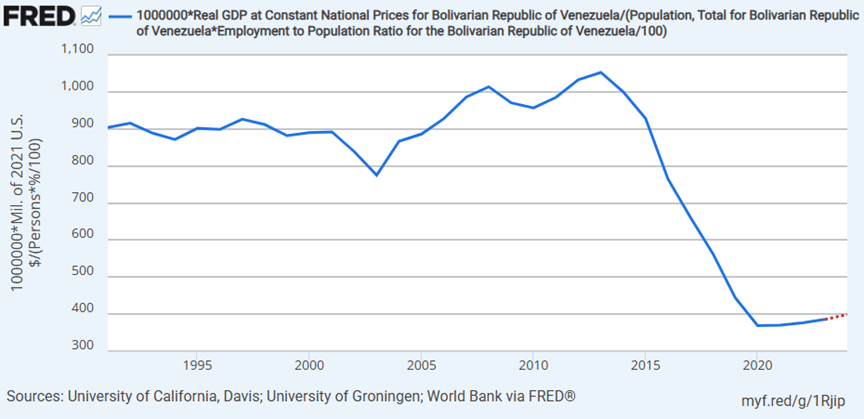
The Federal Reserve Bank of St. Louis reports that Venezuela’s productivity collapsed over the past decade of communist rule, with output per worker — a key driver of living standards — falling from about $1,014 in 2008 to roughly $391 by 2025 based on data through 2023 and IMF projections.
This steep decline contrasts sharply with more stable productivity in other major oil producers and highlights how Venezuela’s command economy, shrinking workforce, and low output continue to suppress economic improvement and living standards. FRED writes:
Output per worker measures how much economic output the average employed person produces in a given period. This measure is intimately related to labor productivity and is a core driver of living standards, as it tends to lead to higher wages.
Data on Venezuela’s output per worker
Real GDP: We have limited up-to-date data on the Venezuelan economy, so we must proceed cautiously with some projected numbers where data are unavailable. FRED has data on real output (GDP) for Venezuela until 2023. So we add real GDP growth estimates from the International Monetary Fund to our discussion. The IMF estimates that Venezuela’s real GDP grew by 5.3% between 2024 and 2025.
At the onset of the Great Financial Crisis in 2008, Venezuela’s real GDP was $17 billion. As of 2025, Venezuela’s GDP was $5.6 billion.
Employment: The number of employed workers is obtained by multiplying the country’s population by its employment-to-population ratio, both available in FRED until 2024. We use the 3-year average growth rate of these variables to predict values for 2025. Venezuela had about 17 million people employed in 2008. That number fell to 14 million people in 2025 after a decline in both population and employment ratios, as a result of difficulties accessing food, housing, healthcare, and security.
Venezuela’s recent turmoil
As we see in our FRED graph above, Venezuela’s real output per worker has plummeted since 2013. The average Venezuelan worker used to generate $1,014 of goods and services in 2008. In 2025 that worker generated only $391 of goods and services. Despite the mass exodus of Venezuelans who left the country starting in 2016, real output also sharply contracted, as discussed in an older post.
Other oil-producing countries
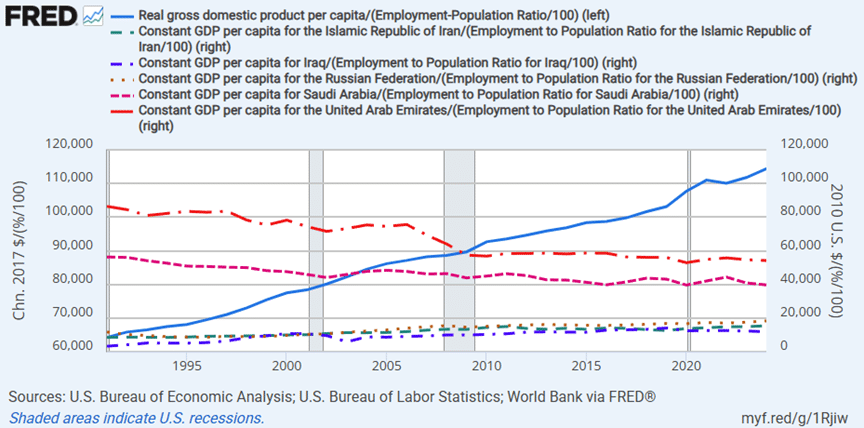
Our second FRED graph (above) shows the same output-per-worker statistic for the US and 5 other major oil producers: Iran, Iraq, Russia, Saudi Arabia, and the United Arab Emirates.
Unlike Venezuela’s output per worker, the other major oil-producing countries experienced a fairly stable trend in output over the past two decades. For instance, the average worker in the United Arab Emirates generated $54,181 in goods and services in 2024 (vs. $399 in Venezuela). The output per worker in Iran, Iraq, and Russia was around $12,000 to $18,000; in Saudi Arabia $39,683; and in the US $114,303.
To produce the same level of output from one US worker in 2024, Venezuela would need 286 workers, when it used to need 87 in 2008.
The takeaway
Viewing Venezuela through the lens of output per worker highlights the scale of the country’s challenges. Venezuelan workers today produce far less than a decade ago and significantly less than workers in other oil-producing countries. Without a sustained recovery in productivity, improvements in living standards are likely to remain limited.