
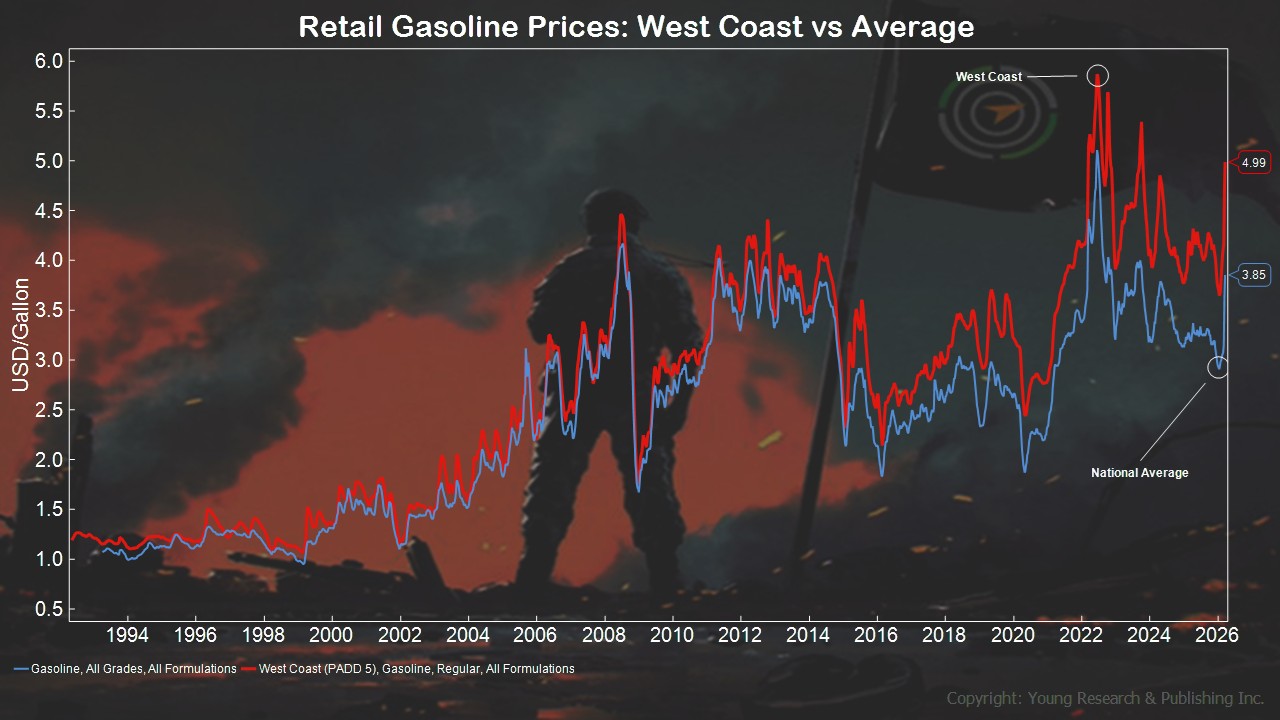
California has an oil problem. There’s not enough of it, and prices for oil products like gasoline are far higher in California than in other areas of the country. You can see on my chart below that the price difference between the West Coast gasoline and the American average has grown to $1.14 per gallon. This is a new phenomenon. Up until around 2012, prices for gasoline on the West Coast were roughly the same as the national average. Since then, the disparity has widened.
 The West Coast has no major crude oil pipeline connecting it to the country’s large oil production areas in Texas, North Dakota, the Gulf of America, or even Alaska. Thankfully, California has lots of oil of its own and is the eighth-largest state for crude oil production. But since 1985, that production has been declining, forcing imports via expensive rail transport or via tanker deliveries from foreign countries.
California is also home to 9% of America’s crude oil refining capacity. In the face of shortfalls of crude production, California’s refineries have begun processing oil imported from foreign countries. The reliance on foreign oil in one of America’s largest economies is one reason given by the Trump administration for its recent order to open up pipeline access to Sable Offshore, an oil production company that operates the disputed Santa Ynez Pipeline System. Secretary of Energy Chris Wright announced the order on March 13, with the department explaining in a press release:
U.S. Secretary of Energy Chris Wright today directed Sable Offshore Corp. to restore operations of the Santa Ynez Unit and Santa Ynez Pipeline System to address supply disruption risks caused by California policies that have left the region and U.S. military forces dependent on foreign oil. This action issued under authorities provided by the Defense Production Act and delegated through Executive Order, “National Defense Resources Preparedness,” as amended by President Trump’s Executive Order, “Adjusting Certain Delegations Under the Defense Production Act.”
“The Trump Administration remains committed to putting all Americans and their energy security first,” Secretary Wright said. “Unfortunately, some state leaders have not adhered to those same principles, with potentially disastrous consequences not just for their residents, but also our national security. Today’s order will strengthen America’s oil supply and restore a pipeline system vital to our national security and defense, ensuring that West Coast military installations have the reliable energy critical to military readiness.”
Sable’s facility can produce approximately 50,000 barrels of oil per day, a 15 percent increase to California’s in-state oil production, that can replace nearly 1.5 million barrels of foreign crude each month.
California once supplied nearly 40 percent of U.S. oil production, but decades of radical state policies targeting reliable energy sources have driven a decline in domestic output while fuel demand remains among the highest in the nation. Today, more than 60 percent of the oil refined in California comes from overseas, with a significant share traveling through the Strait of Hormuz—presenting serious national security threats.
Unlike other regions of the country, California remains largely disconnected from interstate crude pipelines that move American oil to refineries across the United States. The action also prioritizes pipeline transportation capacity to ensure crude produced offshore California moves through the Las Flores Pipeline System to Pentland Station and into interstate pipelines, allowing American energy to reach domestic refineries more efficiently, while reducing California’s reliance on foreign oil vulnerable to geopolitical disruption.
California’s radical governor, Gavin Newsom, shot back with a response condemning the order. His office quoted the governor as saying:
Donald Trump started a war, admitted it would spike gas prices nationwide, and told Americans it was a small price to pay. Now he’s using this crisis of his own making to attempt what he’s wanted to do for years: open California’s coast for his oil industry friends so they can poison our beaches. This wouldn’t lower prices by a cent. This is an attempt to illegally restart a pipeline whose operators are facing criminal charges and prohibited by multiple court orders from restarting.
California will not stand by while the Trump administration attempts to sacrifice our coastal communities, our environment, and our $51 billion coastal economy. The Trump administration and Sable are defying multiple court orders, and we will see them back in court.
Sable Offshore announced on March 16 that it has resumed oil flows through its pipelines and that it expects the flow rate to grow to 50,000 barrels a day. The company’s press release explained:
On March 13, 2026, President of the United States, Donald J. Trump, signed an Executive Order to, among other things, delegate certain authorities under the Defense Production Act of 1950 (“DPA”) to the United States Secretary of Energy. Subsequently on March 13, 2026, the United States Secretary of Energy, Chris Wright, issued an order to Sable invoking the DPA (the “DPA Order”) to immediately prioritize and allocate pipeline transportation services for hydrocarbons from the SYU through the SYPS in order to address the energy scarcity and supply disruption risks caused by California policies that have left the region and U.S. military forces dependent on foreign oil. Sable immediately complied with this federal DPA Order and began shipping hydrocarbons from LFC to Pentland Station on March 14, 2026 with federal safety regulators present in observance.
As stated in the DPA Order, all federally produced barrels from the SYU must flow through the SYPS, up to the existing pipeline capacity of 200,000 Bbls/d. Sable completed its onshore anomaly repair program and hydrotested all segments of the SYPS consistent with applicable requirements as of May 2025.
Prior to resuming hydrocarbon transportation from LFC to Sable’s sales point at Pentland Station, Sable had approximately 540,000 barrels of processed crude oil in storage at LFC, representing more than the line fill volume for the SYPS between LFC and Pentland Station. Sable is fully staffed and will continue to implement the conditions of the Emergency Special Permit previously issued by the United States Department of Transportation, Pipeline and Hazardous Materials Safety Administration.
Sable is currently producing hydrocarbons from its Platform Harmony at the SYU and our wells continue to perform as expected. Production ramp-up is anticipated to proceed with full production resumption at Platforms Harmony and Heritage this month, in March 2026, and Platform Hondo in June 2026. The Company plans to commence first sales by April 1, 2026 at an expected gross oil rate of 50,000 Bbls/d.
Action Line: Energy security is important for residents, businesses, and the fifty military installations in America’s western region. Rejuvenating California’s oil industry will cut prices for Californians and boost the area’s economy, which has been strangled by regulation for years. If your business is in California, and you’re looking to escape, begin your search with Your Survival Guy’s 2026 Super States. And click here to subscribe to my free monthly Survive & Thrive letter.
Originally posted on Your Survival Guy.