Brazil has more than doubled its LNG regasification capacity since 2020, reaching 5.1 Bcf/d in 2025, driven by new terminals and an integrated LNG-to-power strategy. Coastal LNG facilities supply regions without pipelines and back up the country’s renewable-heavy grid, helping offset hydropower shortfalls during droughts. The US supplied 72% of Brazil’s LNG in 2024, while domestic production and imports from Bolivia and Argentina supplement demand. Regulatory reforms and long-term contracts are supporting further growth and energy security. The EIA writes:
Companies operating in Brazil have expanded the country’s liquefied natural gas (LNG) regasification infrastructure since 2020, more than doubling its import capacity as the country seeks to diversify its energy supply and enhance energy security. Brazil’s regasification capacity grew from 2.5 billion cubic feet per day (Bcf/d) in 2020 to 5.1 Bcf/d in August 2025.
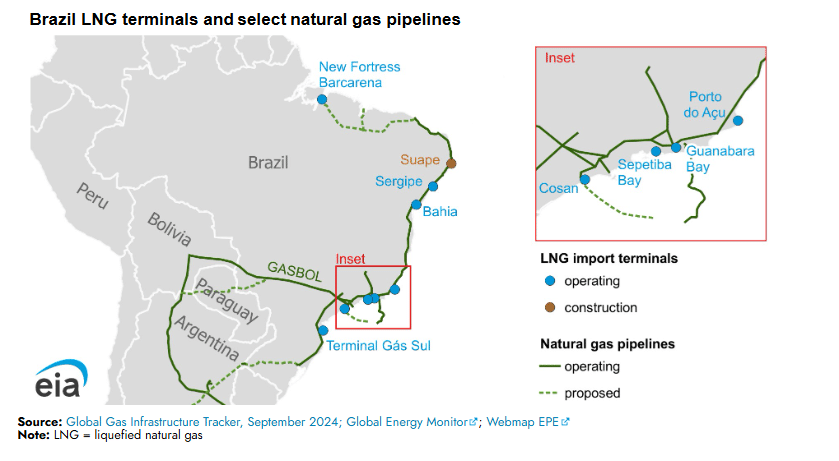
In 2024, three new terminals added an estimated 1.74 Bcf/d of capacity: New Fortress Energy’s Barcarena Floating Storage and Regasification Unit (FSRU) with a capacity of 0.75 Bcf/d, Terminal Gás Sul FSRU (0.50 Bcf/d), and Compass Gás & Energia’s Cosan terminal (0.50 Bcf/d). Terminals installed prior to 2024 include Sepetiba Bay FSRU (0.36 Bcf/d), Porto do Açu FSRU (0.74 Bcf/d), Sergipe FSRU (0.74 Bcf/d), Bahia FSRU (0.71 Bcf/d), and Guanabara Bay FSRU (0.80 Bcf/d).
The Suape FSRU terminal in Pernambuco is under development and scheduled for completion in early 2026 with an expected 0.7 Bcf/d of capacity.
Strategic drivers for LNG regasification expansion
Brazil’s rapid expansion of LNG regasification capacity is driven by a deliberate integrated LNG-to-power strategy. Each new import facility is paired with large natural gas-fired power plants. For example, at the Barcarena terminal, developers are building the 2.2 gigawatt (GW) Novo Tempo Barcarena power station (including the CELBA 2 Power Plant, which began early stage operations in October). The Port of Açu LNG terminal is associated with the 1.7 GW GNA II natural gas-fired power plant, which began operations in May.
Regulatory mandates have significantly accelerated Brazil’s LNG import capacity growth. In addition to establishing the privatization of Eletrobras, Federal Law 14,182/2021 required 8 GW of new regionalized natural gas power plant contracting capacity. The New Gas Law (14,134/2021) broke Petrobras’s monopoly over natural gas production, transportation, and distribution, opening terminals to private developers and allowing multiple users to use a terminal to add natural gas to the pipeline system.
Coastal LNG terminals supply natural gas to regions lacking pipeline access and provide flexible backup for a grid heavily reliant on renewable energy. About 80% of Brazil’s electricity is generated from hydropower, wind, and solar. The increased LNG regasification capacity adds flexibility to the country’s integrated power grid, which is particularly susceptible to droughts due to its high dependence on hydropower.
Although hydropower constituted 56% of Brazil’s electricity generation in 2024, significant flow reductions during droughts pose a concern that hydro generation may decrease. Although they haven’t significantly affected hydrogeneration, recent droughts have highlighted system vulnerabilities, with reservoir levels in key regions falling to 29% of capacity in 2024. Natural gas-fired plants, often linked to LNG terminals, typically increase generation during these periods to offset hydropower declines.
Supply dynamics
The United States supplied 72% of Brazil’s LNG imports in 2024. Although Brazil primarily procures LNG supplies in global spot markets due to seasonal demand variability, it is shifting toward long-term contracts to achieve price stability. Notable examples include the Centrica-Petrobras agreement with Petrobras for 0.8 million tons annually over 15 years starting in 2027 and New Fortress Energy’s long-term industrial contracts with Norsk Hydro’s Alunorte refinery for its Barcarena operations.
In addition to LNG imports, Brazil also imports natural gas from Bolivia and from Argentina via the GASBOL pipeline.
Brazil’s domestic natural gas production reached 5.4 Bcf/d in 2024, with offshore fields accounting for 85% of the output. However, 54% of the natural gas produced is reinjected for reservoir pressure maintenance.