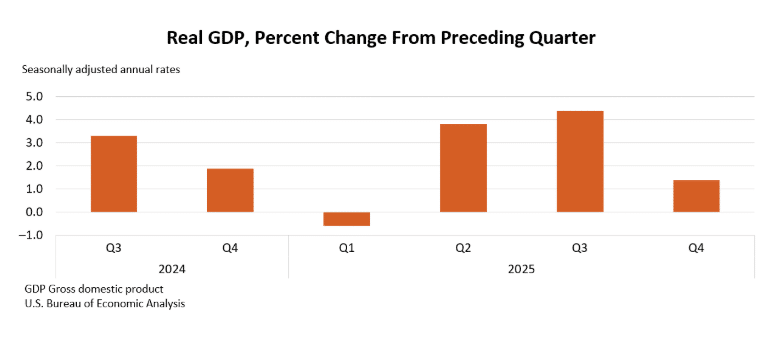
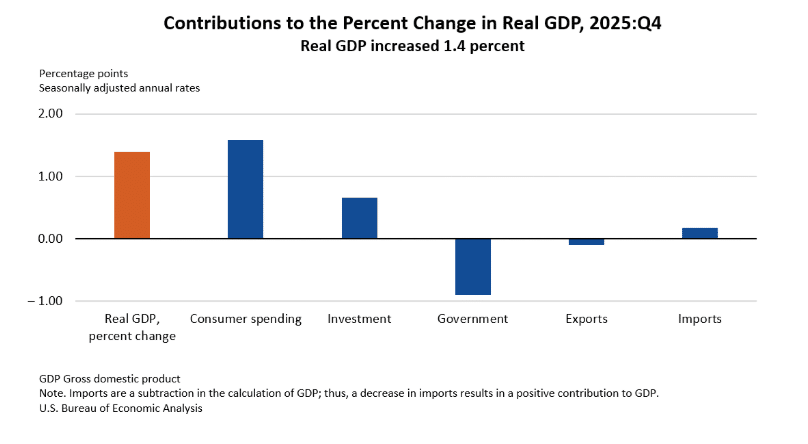
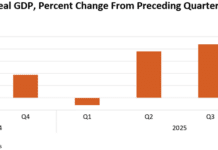
The US Bureau of Economic Analysis (BEA) reported that real GDP grew at an annualized rate of 1.4% in the fourth quarter of 2025, slowing sharply from 4.4% in the third quarter. Growth was driven by consumer spending and investment, but declines in government spending and exports weighed on the overall pace. Imports fell, which partially supported GDP.
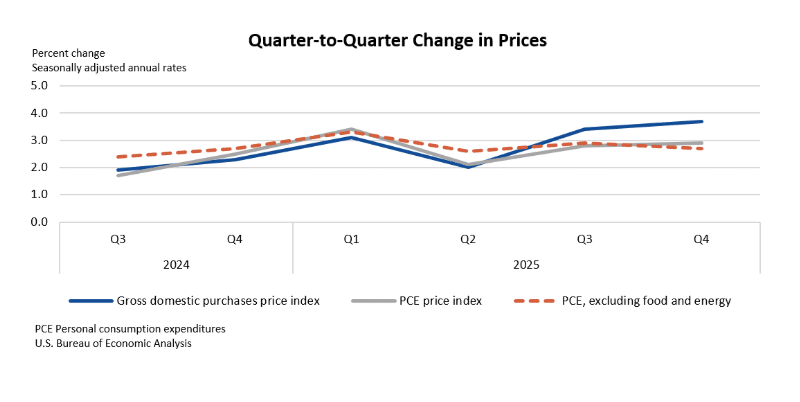
For full-year 2025, the economy expanded 2.2%, down from 2.8% in 2024, with consumer spending and investment leading gains. Inflation measures ticked slightly higher in the fourth quarter, with the PCE price index rising 2.9%, while core PCE (excluding food and energy) increased 2.7%. The BEA writes:
Real gross domestic product (GDP) increased at an annual rate of 1.4 percent in the fourth quarter of 2025 (October, November, and December), according to the advance estimate released today by the U.S. Bureau of Economic Analysis. In the third quarter, real GDP increased 4.4 percent.
The advance report for the fourth quarter of 2025, originally scheduled for January 29, 2026, was rescheduled due to the October–November 2025 government shutdown.
The contributors to the increase in real GDP in the fourth quarter were increases in consumer spending and investment. These movements were partly offset by decreases in government spending and exports. Imports, which are a subtraction in the calculation of GDP, decreased. For more information, refer to the “Technical Notes” below.
Compared to the third quarter, the deceleration in real GDP in the fourth quarter reflected downturns in government spending and exports and a deceleration in consumer spending that were partly offset by an acceleration in investment. The decrease in imports was smaller than in the prior quarter.
Real final sales to private domestic purchasers, the sum of consumer spending and gross private fixed investment, increased 2.4 percent in the fourth quarter, compared with an increase of 2.9 percent in the third quarter.
The price index for gross domestic purchases increased 3.7 percent in the fourth quarter, compared with an increase of 3.4 percent in the third quarter. The personal consumption expenditures (PCE) price index increased 2.9 percent, compared with an increase of 2.8 percent. Excluding food and energy prices, the PCE price index increased 2.7 percent, compared with an increase of 2.9 percent. (Refer to “Technical Notes” below for information on how BEA imputed missing Bureau of Labor Statistics (BLS) October prices.)
Real GDP and Related Measures
[Percent change (SAAR) from 2025 Q3 to Q4]
Advance estimate
Real GDP
1.4
Current-dollar GDP
5.1
Real final sales to private domestic purchasers
2.4
Gross domestic purchases price index
3.7
PCE price index
2.9
PCE price index excluding food and energy
2.7
GDP for 2025
Real GDP increased 2.2 percent in 2025 (from the 2024 annual level to the 2025 annual level), compared with an increase of 2.8 percent in 2024. The increase in real GDP in 2025 primarily reflected increases in consumer spending and investment.
The price index for gross domestic purchases increased 2.6 percent in 2025, compared with an increase of 2.4 percent in 2024. The PCE price index increased 2.6 percent, the same increase as in 2024. Excluding food and energy prices, the PCE price index increased 2.8 percent, compared with an increase of 2.9 percent.