

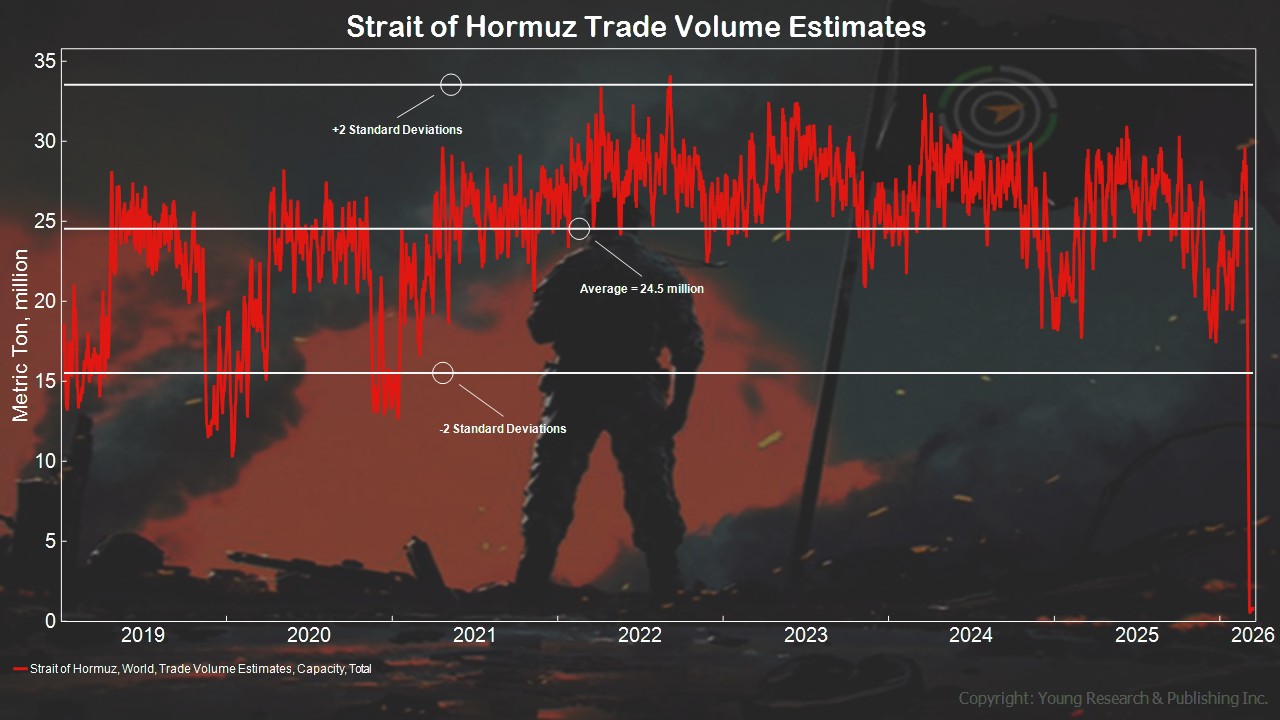
According to various estimates, the Strait of Hormuz is the transit point for between 20 million and 26 million barrels a day of crude oil. Since the war broke out between the combined forces of Israel and the United States on one side and Iran on the other, the capacity of oil transit through the strait has fallen to less than 1 million barrels a day. You can see on my chart that this drop is far below a negative two standard deviation difference from the average.
 According to the IEA, there is limited capacity for redirection, with pipelines in Saudi Arabia and the UAE able to move between 3.5 and 5.5 million barrels a day to avoid the strait.
 Even with those pipelines running at maximum capacity, a minimum of 75% of normal flows through the strait will be stranded. With that reality sinking in, WTI crude oil prices closed at $98/barrel yesterday, the highest since the war began.

It’s not just oil that flows through the strait either. Almost 20% of seaborne LNG supply flows through the strait as well. Asian markets depend heavily on that supply, mostly from Qatar, which has no alternate export route for the gas.
According to the IEA:
Bangladesh, India and Pakistan imported almost two-thirds of their total LNG supplies via the Strait of Hormuz in 2025, making them particularly vulnerable to potential disruptions to transit flows.
Moreover, natural gas dominates the power sector of Bangladesh and Pakistan, with gas-fired generation accounting for 50% and 25% of their electricity supply mix, respectively, in 2024. Inadequate LNG supplies would cause a deterioration of electricity supply security in those price sensitive markets and could lead to production curtailments in their gas-intensive industries, including fertilisers.
The effects of the supply shock would be felt well beyond the markets directly relying on Qatari and Emirati LNG, however. The shortfall in these supplies would naturally exacerbate the competition for spot LNG volumes and put strong upward pressure on spot LNG prices both in Asia and Europe. A supply shock of such magnitude will ultimately necessitate demand side adjustments, including minimising gas-fired generation in the power sector, mandated demand savings in public buildings and production curtailments in the gas- and energy-intensive industrial sectors.
Action Line: What can investors do? Investors with diversified portfolios and solid plans should remain diligent, but take comfort in knowing they have prepared for turmoil. If your investments aren’t diversified in a portfolio of stocks and bonds, email me at ejsmith@yoursurvivalguy.com to discuss your risk tolerance. And click here to subscribe to my free monthly Survive & Thrive letter.
Originally posted on Your Survival Guy.