The International Energy Agency’s Gas 2025 Analysis and Forecasts to 2030
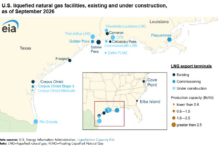
report shows that global natural-gas demand growth has slowed to below 1 % in 2025, even as a major wave of liquefied natural-gas (LNG) export capacity—about 300 billion cubic metres per year by 2030—is coming online and expected to reshape supply dynamics. While the Asia-Pacific region is set to drive most demand growth toward 2030, supply from North America and Qatar will dominate new expansions. Meanwhile, long-term contracts and carbon-capture technologies are highlighted as key tools for managing market flexibility, affordability, and emissions intensity of the global gas trade. The EIA writes:
Following a relatively strong increase in 2024, global gas demand growth slowed markedly in Q1-Q3 2025. Higher natural gas prices, together with heightened macroeconomic uncertainty and tight supply fundamentals, weighed on natural gas consumption. In contrast with previous years, demand growth was largely concentrated in Europe, while in Asia, natural gas consumption remained broadly flat compared with the same period in 2024.
Preliminary data suggest that natural gas demand increased by just 0.5% (or around 10 bcm) year-on-year in Q1-Q3 2025 in the markets covered by this update, primarily driven by Europe and North America. Supply fundamentals remained tight. While global LNG supply increased by around 5% (or nearly 20 bcm) year-on-year in Q1-Q3 2025, this was partially offset by lower Russian and Norwegian piped gas deliveries to Europe. Strong storage injections in the European Union further tightened market fundamentals.
For the full year of 2025, global gas demand growth is expected to increase by less than 1%, assuming average weather conditions in Q4. Natural gas demand in the Asia Pacific region is expected to expand by less than 1% compared with 2024, its weakest growth since 2022. Following a cold Q1, the year’s natural gas demand in North America is projected to increase by around 0.5% compared with 2024 and remain broadly flat in Central and South America. In Europe, natural gas demand is expected to increase by 3%.
Eurasian gas demand is projected to decline by 1.5%. Combined gas demand in Africa and the Middle East is forecast to increase by 2%, amid higher demand in industry and the power sectors.
Global gas consumption is expected to reach a new all-time high in 2026, with demand growth accelerating to 2%. Global LNG supply is forecast to increase by a strong 7% (or 40 bcm), primarily driven by the United States, Canada, and Qatar. Improving supply fundamentals are expected to support stronger demand, especially in fast-growing and price-sensitive Asian markets.
Read more here.