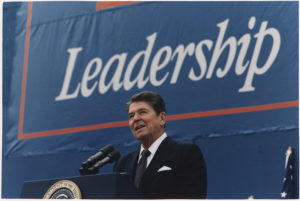
“Life on Main Street hasn’t been this hard in a while,” writes Your Survival Guy on the inside, back cover, of The American Conservative. “When I go back to Mattapoisett, MA, where I grew up, and walk up my parents’ stairs, there’s a picture that always stops me in my tracks. It’s of the two of them wearing Ronald Reagan hats at the 1980 Republican National Convention in Detroit.”
When you think about that time in America, you know the country was at a crossroads. Reagan inherited runaway inflation and an economy on the ropes. Would he be able to work with Federal Reserve Chief Paul Volcker and ring in a brighter morning in America? Judy Shelton, monetary economist, senior fellow at the Independent Institute, and author of “Money Meltdown,” writes in the WSJ:
The Reagan plan consisted of four parts: “(1) substantial reduction in the growth of federal expenditures, (2) significantly reduced federal tax rates, (3) prudent relief of federal regulatory burdens, and (4) a monetary policy on the part of the independent Federal Reserve System consistent with those policies.”
Shelton continues:
While deficit spending is an affront to the notion of sound money and compromises the role of central banking in funding government, there’s a difference between fiscal outlays for current consumption—financed by yet-to-be-realized budget revenues—and tax incentives that will spur more production down the road. Government borrowing to finance socialist redistribution isn’t the same as government borrowing to invest in entrepreneurial capitalism.
With reckless spending during Covid and today, it’s clear this administration isn’t interested in pro-business solutions. There’s no indication they’re working for the forgotten man on Main Street. Picking his pockets is more like it.
James Freeman from the WSJ adds this:
President Reagan used to say that government is not the solution to our problems; government is the problem. Perhaps this basic insight was the reason he won two landslide presidential elections. Nearly four decades after the second of those landslide victories, a lot of Americans still agree with him.
“More Americans name the government as the nation’s top problem in Gallup’s latest poll,” reports the survey organization’s Megan Brenan. When asked to name the “most important problem facing this country,” 21% cite “The government/Poor leadership.”
This is the most popular answer in the survey, and there’s not much of a partisan divide, according to Gallup:
The government ranks as the top problem for both Republicans and Republican-leaning independents (24%) and Democrats and Democratic-leaning independents (18%).
As for the other top answers given by survey participants, one could argue that they also represent government failure—and voter recognition of the resulting damage. Ms. Brenan notes:
Action Line: The fight for the forgotten man on Main Street America is worth every penny. Let’s go.
Originally posted on Your Survival Guy.