
As the popularity of ETFs grows, so too does the popularity of investing in market capitalization weighted indices. The largest ETFs with the most YTD inflows are the capitalization weighted SPDR S&P 500 ETF, the iShares Core S&P 500 ETF, and the Vanguard S&P 500 ETF. According to Bloomberg, YTD inflows are almost $50 billion at these three ETFs and assets under management amount to $375 billion.
All three funds of course track the 500 stocks in the S&P 500. Most investors then logically assume that if they own an S&P 500 ETF, their assets are diversified across 500 different stocks. Technically that is correct, but practically, an S&P 500 fund doesn’t provide as much diversification as one might assume.
Almost half of the assets in an S&P 500 ETF are invested in the top 50 names. And it is the top 50 names that drive the lion’s share of performance of these funds. The other 450 stocks owned in an S&P 500 ETF are basically irrelevant.
The chart below compares the performance of the S&P 500 to the Russell Top 50 Index. The Russell Top 50 index is a market capitalization weighted index of the 50 largest companies measured by market value.
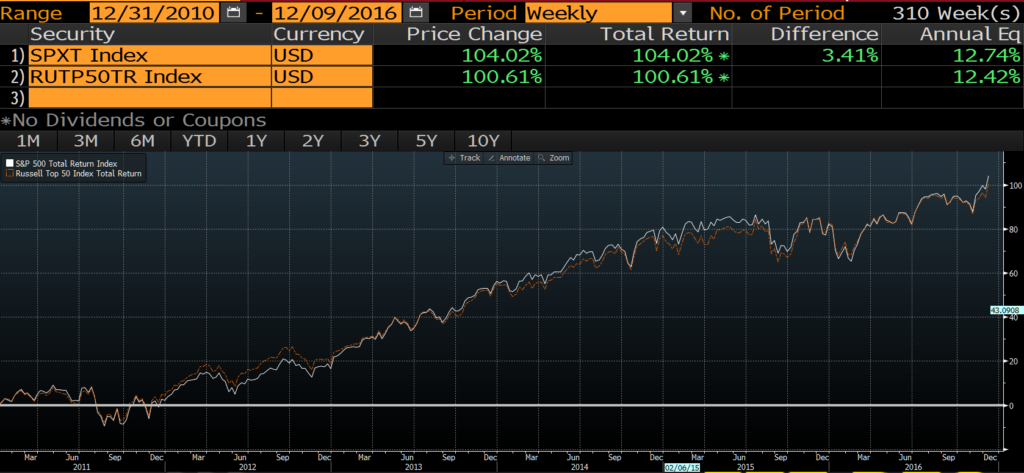
See any significant difference in performance here?
Don’t be conned into thinking that you gain greater diversification by investing in a market capitalization weighted S&P 500 ETF.
For more on the perils and pitfalls of investing in market capitalization weighted indices see here, here, and here.